Table of Contents
So this guide starts with the decision rather than the sights. Once you know whether you are doing one long day or one night, everything else — which train, which road, which hotel — follows on its own.
Disclosure: This article may contain affiliate links. If you make a booking through one of these links, we may earn a commission at no additional cost to you.
Information last verified: 2026-07-26. Train timetables, park fees, opening hours and hotel facilities in Thailand change often; treat every figure here as approximate and confirm before you travel.
The one thing that decides your trip
Kanchanaburi town sits about two to three hours west of Bangkok. From there, the two headline attractions pull in different directions.
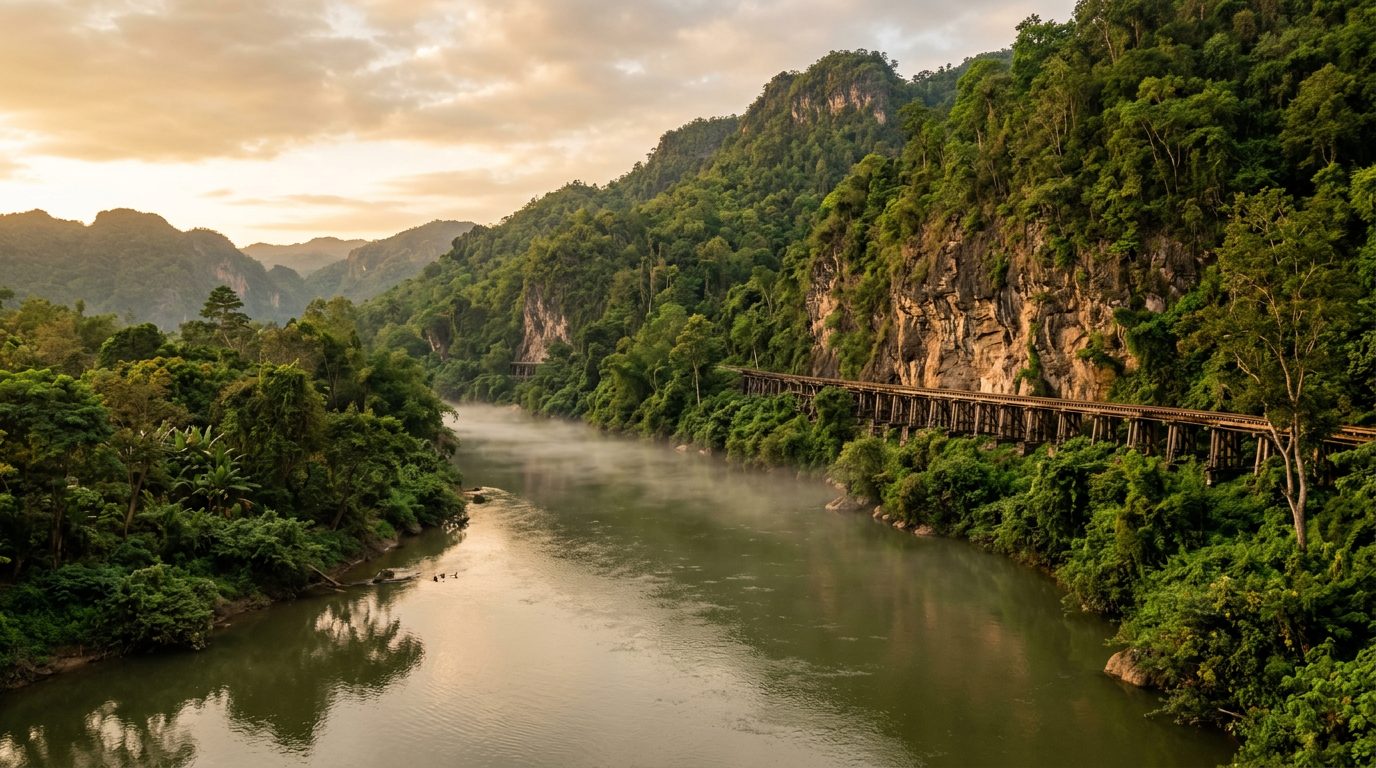
The Death Railway runs west and northwest out of town, over the Bridge over the River Kwai, along the Tham Krasae viaduct, and up to the end of the line at Nam Tok. Beyond that, by road, is the Hellfire Pass Memorial — roughly 80 km northwest of Kanchanaburi town.
Erawan National Park is also northwest of town, but on a different road entirely. It is not a stop on the railway corridor and it is not somewhere you pass on the way to anything else. It is its own out-and-back drive.
That geography is the whole problem. You can ride the railway or you can spend a proper morning at the waterfall. Doing both well in one day, starting and finishing in Bangkok, is not realistic — and the train timetable makes the point for you, as you will see in a moment.
Getting there from Bangkok
By train — the atmospheric option
Trains to Kanchanaburi leave from Thonburi station on the west bank, not from Hua Lamphong or Krung Thep Aphiwat. Plenty of visitors have discovered this the hard way. Thonburi is about a 750-metre, nine-minute walk from Bang Khun Non station on the MRT Blue Line, which makes it easy to reach from most of central Bangkok — see our Bangkok BTS and MRT guide if you are still getting your bearings on the rail network.
The main service is train 257, which leaves Thonburi around 07:45, reaches Kanchanaburi about 10:20, crosses the famous bridge a few minutes later, passes the Tham Krasae viaduct around 11:36, and terminates at Nam Tok about 12:05. That is roughly four hours and twenty minutes for the full run. There is a second, early-afternoon departure as well, but it arrives too late in the day to be useful unless you are staying over.
These are third-class, non-air-conditioned ordinary trains with open windows and wooden-slat benches. The foreigner fare for the Kanchanaburi stretch is around 100 baht. The lack of air conditioning is not the hardship it sounds like — the windows are the point.
On weekends there is also a separate air-conditioned tourist railcar from Bangkok, leaving around 06:30, reaching Kanchanaburi about 09:25 and Nam Tok about 11:30, returning from Nam Tok in the early afternoon. It needs advance reservation and charges special fares. Confirm it is still running before you build a plan around it.
By minivan — the practical option
Minivans leave frequently from Bangkok’s Southern Terminal (Sai Tai Mai), the Mo Chit new van terminal, and Khao San, and take roughly two to three and a half hours depending on traffic and where you start. Fares run in the region of 130 to 250 baht.
This is what you take if the waterfall is your priority. It gets you into Kanchanaburi early enough to actually use the day.
By car
A hired car or private driver costs considerably more but solves the real problem: Erawan, Hellfire Pass and the railway are spread across a wide area with thin public transport between them. If there are three or four of you, this is often the sensible choice — and it is the only option that makes a genuine day trip covering more than one area feasible.
Riding the Death Railway, and its awkward timetable
Here is the number that shapes everything. Train 257 arrives at Nam Tok around 12:05. The main return service, train 258, leaves Nam Tok just after 13:00.
That gives you under an hour at the end of the line.
It is enough for a stretch, a drink and a look around the small station. It is not enough for anything else. And by the time 258 gets you back to Thonburi in the late afternoon, your day is gone.
Timetables on this line have changed repeatedly over the years, and different sources list different return options. Check the current State Railway of Thailand timetable before you commit to a plan built around a specific return train.
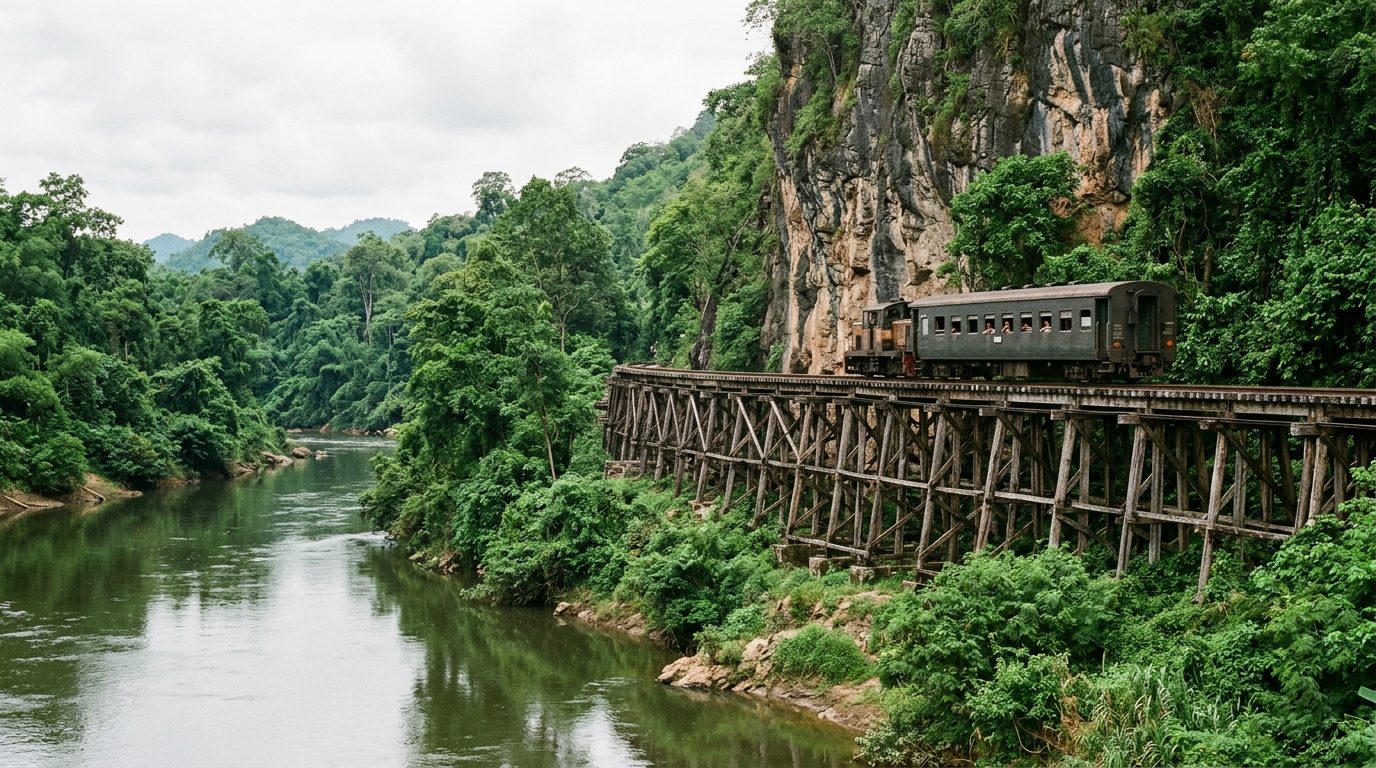
What you actually come for happens en route, not at the terminus. The train crosses the Bridge over the River Kwai shortly after Kanchanaburi station, and about an hour later runs along the Tham Krasae (Wang Pho) viaduct — a wooden trestle structure built along a cliff face directly above the river. The train slows to a crawl across it, and the timetable itself builds in an extended pause at the station there. It is the single most striking few minutes of the journey.
A note on how to hold all this. The railway was built by Allied prisoners of war and conscripted Asian labourers under the Japanese occupation, at an enormous cost in lives. It is a memorial as much as an attraction. The Kanchanaburi War Cemetery in town holds almost 7,000 graves. Photographs are fine; the mood at these sites is quiet, and it is worth matching it.
Option A: one long day from Bangkok
Doable, but pick one thread.
The railway day. Take the 07:45 train from Thonburi. Ride the whole line to Nam Tok, turn around on the early-afternoon service, and be back in Bangkok by evening. You will see the bridge, the viaduct and the river valley from the window. You will not see Erawan, Hellfire Pass, or much of Kanchanaburi town.
The waterfall day. Take an early minivan or a car, go straight to Erawan National Park, spend the morning and early afternoon walking up the tiers, then head back. You will get the best of the park and miss the train entirely.
The town day. Minivan out, spend the day between the War Cemetery, the Thailand–Burma Railway Centre and the bridge itself, ride the short train hop from Kanchanaburi station across the bridge and back, and return in the evening. This is the most balanced single day and the one most people underrate.
If a single tightly-packed day is what you have, honestly consider Ayutthaya instead — it works cleanly as one day in a way Kanchanaburi does not.
Option B: one night — the trip Kanchanaburi is actually built for
Give it a night and the whole thing relaxes.
Day one: travel out in the morning by minivan or car. Afternoon in town — War Cemetery, railway museum, the bridge at golden hour. Check into somewhere on the river. Eat by the water.
Day two: early start for Erawan, up the tiers before the crowds and the heat, back down for lunch, then either the road to Hellfire Pass or the afternoon train back towards Bangkok.
Or invert it: railway on day one, ending at Nam Tok, with a riverside raft house upstream near Sai Yok; Hellfire Pass first thing on day two, when the memorial is at its quietest.
The overnight also unlocks the thing that makes Kanchanaburi genuinely distinctive as a place to sleep — which is the next section.
Erawan Falls: what to expect
Erawan National Park charges 300 baht for foreign adults and 150 baht for children aged 3 to 14, plus about 30 baht per car or 20 baht per motorbike. Thai residents pay less. Bring cash — foreign visitors generally cannot pay the entrance fee with Thai domestic payment apps out here.
The park opens around 08:00 and closes around 16:30, but the gate stops admitting visitors at 15:30. That cut-off is the one to plan around.
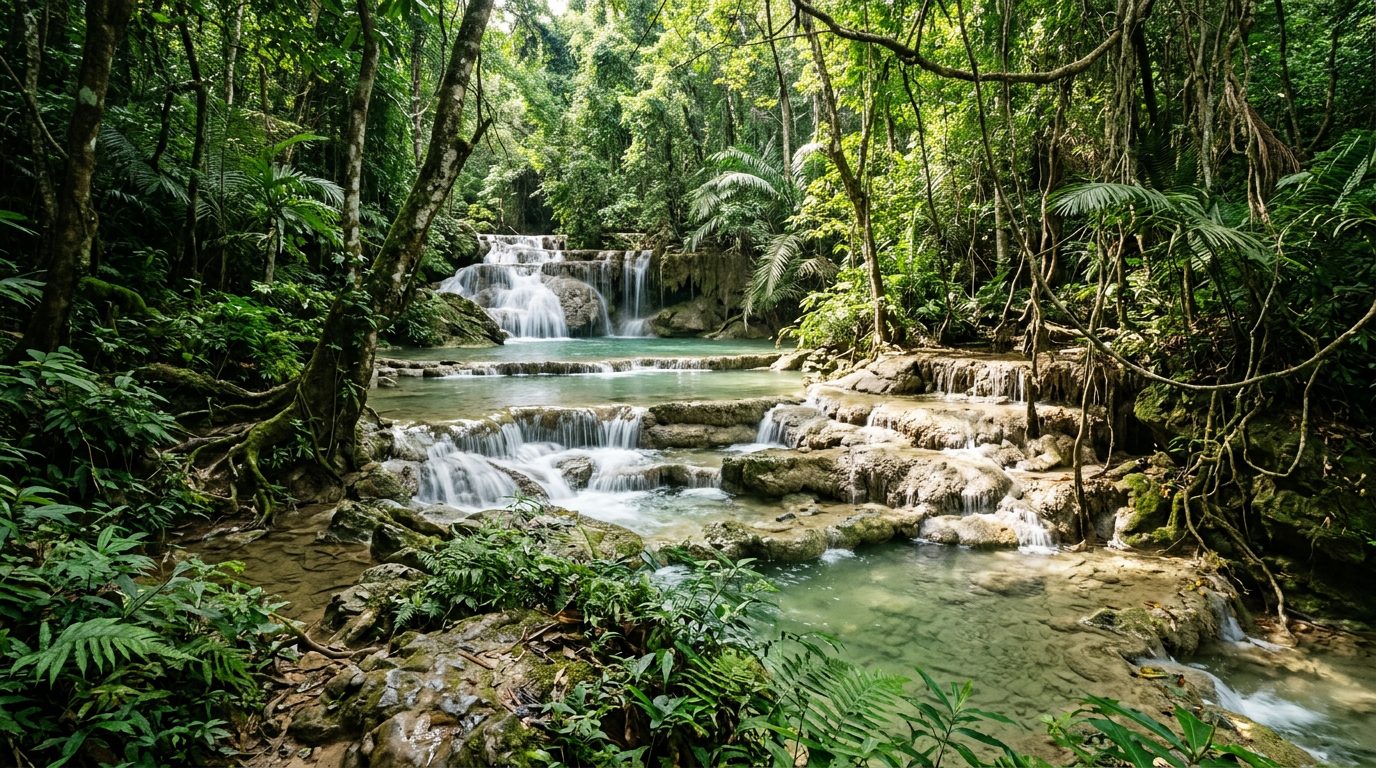
The waterfall has seven tiers. A concrete path runs as far as the sixth; getting to the seventh means scrambling over rock. Most visitors turn around somewhere around the fourth or fifth, which is no failure — the pools lower down are the swimmable ones and, in the middle of a hot day, the better use of your time.
Two practical rules. Food and drink are not allowed past the second tier — you check bottles in at a control point and get a small deposit back when you collect them. And expect to be moved down from the upper tiers in the mid-afternoon, as staff clear and clean the falls from the top down. Arriving at 14:00 hoping for tier seven will not end well.
The little fish in the pools nibble. This is normal and harmless.
Hellfire Pass: the memorial worth the drive
The Hellfire Pass Interpretive Centre sits at Tha Sao, Sai Yok District, roughly 80 km northwest of Kanchanaburi town. It is run with Australian government support and it is, by a distance, the most affecting of the wartime sites.
Admission is free. The centre opens 09:00 to 16:00. The audio guide is free too, with a refundable 200 baht deposit — take it. It carries survivor testimony, and it is what turns the walk from a pleasant path through a cutting into something you will remember.
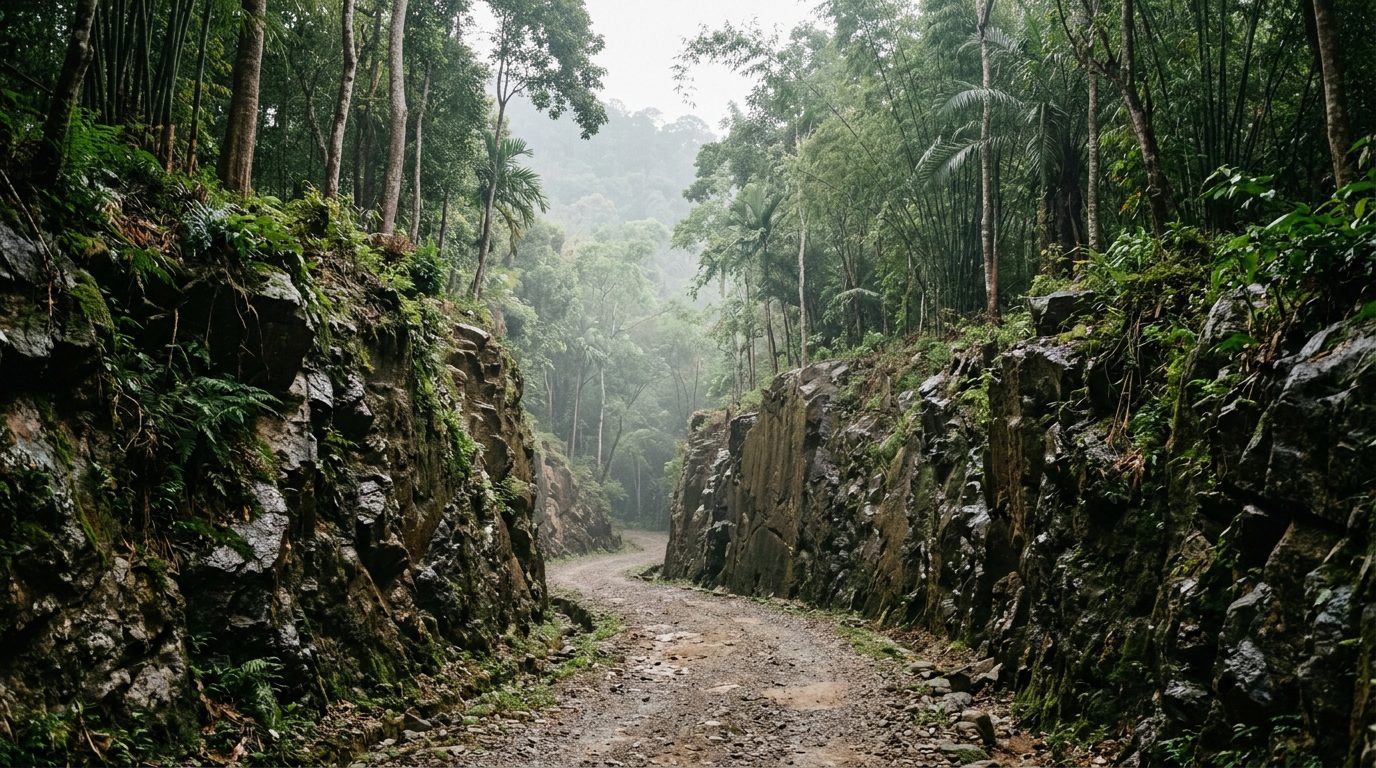
Two routes lead down from the centre: a shorter return walk of about 40 to 45 minutes, and a longer track of around three hours. The short walk reaches the cutting itself, which is the part you came for.
Important: the centre closes for roughly three weeks each May for maintenance — there was a closure in May 2026. If you are travelling in May, check before you drive 80 km.
Where to stay: seven verified River Kwai properties
The signature Kanchanaburi stay is a room that floats. Rafts are moored along the river, some barely furnished, some genuinely luxurious, and the good ones are far enough upstream that the only sound at night is water. This is the reason to stay over rather than day-trip.
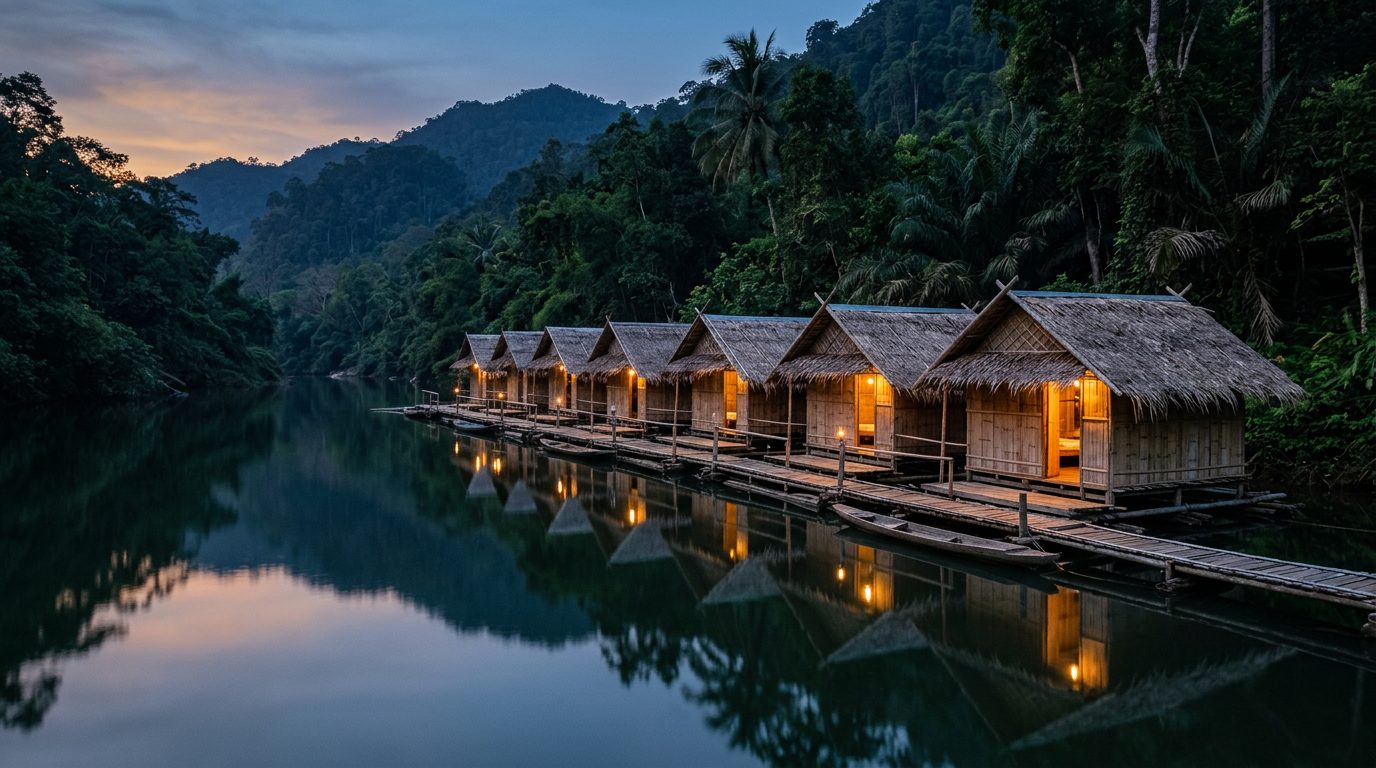
All seven properties below were confirmed as operating in July 2026 against the operators’ own sites or current listings.
Floating rooms upstream
The FloatHouse River Kwai — Wang Krachae, Sai Yok District. Floating villas of about 90 square metres in Thai folk style, with teakwood furniture, thatched roofs and a private terrace and pier over the water. Unlike the more rustic rafts, these have air conditioning, hot water and Wi-Fi. You reach it by longtail boat from the main pier, roughly 20 to 30 minutes upstream — which is exactly why it feels remote. There is a restaurant and bar on site, which matters when there is nothing else within walking distance.
River Kwai Jungle Rafts — Ban Tha Sao, Sai Yok District. The purist version: bamboo raft rooms of about 28 square metres, reached by longboat in around 20 minutes, and no mains electricity. Kerosene lamps at night, and that is the whole point rather than a shortcoming. The property works with and employs the local Mon community, and a Mon village sits alongside it. Come for the river and the quiet; do not come expecting to charge a laptop.
Cross River Kwai — on the Kwai Noi, roughly a 20-minute drive out of town. Formerly branded X2 River Kwai, so older reviews use that name. Six room categories, and the two to care about are the Xfloat Cabin and Xfloat Luxe Cabin, which float directly on the river with rooftop decks; the Luxe adds an outdoor mesh nest bed and a kayak dock. On land there are Luxe Cabins of about 73 square metres and suites up to about 107. Pool, spa, restaurant and bar. This is the design-conscious option.
Near Hellfire Pass
Home Phutoey River Kwai Hotspring & Nature Resort — Tha Sao, Sai Yok District, about 3 km from the Hellfire Pass Memorial and roughly 50 km beyond Kanchanaburi town along Highway 323. Natural hot-spring pools, and the Deluxe Onsen Villa and River View Onsen Villa have private onsen baths — an unusual thing to find in central Thailand. Cabin and log-home style rooms, swimming pools, a restaurant, an on-site WWII museum and gallery in its Peace Park, and a treetop adventure course. If Hellfire Pass is the centre of your trip, sleep here and walk into the memorial at opening time.
In and around town
U Inchantree Kanchanaburi — on the north bank of the Kwai Yai, about a five-minute walk from the Bridge over the River Kwai. A boutique property named after an old Inchan tree on the grounds, with eight room categories from Superior Balcony Garden View up to a Riverside Suite with bathtub, an outdoor pool, and a bar lounge suspended out over the river facing the bridge. The one caveat: you need transport to reach the night market and central town, about 10 to 15 minutes away. Best pick if you want to be at the bridge for sunrise.
Royal River Kwai Resort & Spa — riverside, about 8 km from central Kanchanaburi, roughly 10 to 15 minutes by car. A large year-round outdoor pool with a pool bar, the Rantee Spa set in gardens beside the river, and two restaurants — the Royal indoors and Chomwana outdoors. A comfortable, unhurried base with more space than the in-town hotels, if you have a car.
Which one suits you?
| If you want… | Stay at |
|---|---|
| A floating villa with comfort intact | The FloatHouse River Kwai |
| The river with no electricity and no compromise | River Kwai Jungle Rafts |
| Floating rooms with design and a pool | Cross River Kwai |
| To be at Hellfire Pass when it opens | Home Phutoey River Kwai |
| To walk to the bridge | U Inchantree Kanchanaburi |
| Space, a pool and a spa, with a car | Royal River Kwai Resort & Spa |
Note that the upstream floating properties are a substantial distance from Kanchanaburi town. They are the right base for the railway, Sai Yok and Hellfire Pass — and the wrong base for Erawan, which is on the other road.
Practical tips
- Bring cash. Erawan’s entrance fee, small restaurants and boat transfers are cash-first out here.
- Wear shoes you can get wet. The Erawan path is wet rock in places, and flip-flops are miserable on the upper tiers.
- Book raft houses ahead, especially on weekends and Thai public holidays. There are not many rooms on the water and Thai visitors book them well in advance.
- Check the last boat. Upstream properties run scheduled longtail transfers; arriving after the last one is a real problem.
- May is a risk month for Hellfire Pass because of the annual maintenance closure.
- Skip elephant-riding excursions. They are marketed along the River Kwai and there is no reliable way to verify welfare standards from a brochure. Plenty of operators in Thailand now offer observation-only alternatives.
- Dress modestly at the war sites. These are graves and memorials, not photo backdrops.
- On entry rules: in July 2026 the Thai cabinet approved reducing visa-free stays to 30 days and trimming the eligible list to 59 countries and territories. As of this article the change had not yet taken effect — it applies 15 days after publication in the Royal Gazette. Check your own nationality’s current entitlement before booking.
Frequently asked questions
Can I do Kanchanaburi as a day trip from Bangkok?
Yes, but only one thread of it. The railway day, the Erawan day and the town day are three different trips. Trying to combine the train with the waterfall in one day from Bangkok does not work.
Is the Death Railway train worth it?
For the Tham Krasae viaduct section, yes. The train slows along a wooden trestle built into a cliff above the river, and it is genuinely memorable. The rest of the ride is slow, hot and pleasant. If you only want the highlight, ride the short hop from Kanchanaburi station over the bridge rather than the full four-hour run.
How much time do I need at Erawan Falls?
Three to four hours is comfortable for the lower five tiers with a swim. Arrive before mid-morning — the gate stops admitting visitors at 15:30 and the upper tiers clear earlier than that.
Which is better, Erawan or Hellfire Pass?
Different jobs entirely. Erawan is a half-day of walking and swimming. Hellfire Pass is a short, sober walk with an audio guide that carries survivor testimony. If you have one afternoon and want to understand why the railway is called what it is, go to Hellfire Pass.
Do I need to book a tour?
No, if you have a car or are happy with one thread per day. Yes, or at least a private driver, if you want to combine Erawan with the railway corridor in limited time — the public transport between them is thin.
What are the floating raft houses actually like?
It depends which one. River Kwai Jungle Rafts has bamboo rooms and kerosene lamps with no mains power. The FloatHouse and Cross River Kwai’s Xfloat cabins are air-conditioned and comfortable. All of them are reached by boat and all of them are quiet.
When is the best time to go?
The waterfall runs strongest towards the end of the rainy season, roughly October and November, when the pools are full and the landscape is green. The cool months from November to February are the most comfortable for walking. March to May is hot, and May carries the Hellfire Pass closure risk.
Final thoughts
Kanchanaburi rewards the extra night more than almost any trip within reach of Bangkok. Give it one day and you get a long train ride or a waterfall, and a lot of road. Give it one night and you get the viaduct, the memorial, the falls in the cool of the morning, and a room that floats on the river — which is the part people actually remember.
Plan around the two numbers that matter: the train’s early-afternoon turnaround at Nam Tok, and Erawan’s 15:30 last entry. Everything else falls into place. If Kanchanaburi is one stop in a longer Bangkok week, pair it with the Old Town temple and street food itinerary and sort out your city base first with our Sukhumvit hotel guide.
Image note: Editorial images in this article are generated with AI for illustration. They depict generic River Kwai valley, railway and waterfall scenes and do not represent any specific named hotel, room, raft, memorial or monument.
Leave a Reply