Table of Contents
Almost every "must-try Thai food" list assumes you already know what the dishes are. You do not need another list of twenty photographs. You need to be able to stand at a stall with a Thai-only menu, work out what is in front of you, order it at a heat level you can actually eat, and know whether you are in the right part of the country to be ordering it at all.
That last part matters more than people expect. Thailand has four regional cuisines, and ordering a northern dish on a southern island generally gets you a version made for tourists. This guide is organised the way the food actually is.
Quick answers
- Yes, it can be genuinely hot — but heat varies enormously by region, and asking for it milder is completely normal.
- Southern Thai food is the spiciest. Northern is the mildest. If you are nervous, start in the north.
- Sticky rice in the North and North-east, jasmine rice in the Centre and South. That one fact changes how a whole meal works.
- Order by region, not by list. Khao soi belongs in Chiang Mai, som tam in Isan, massaman in the south.
- For somewhere reliably good and affordable, the MICHELIN Guide Thailand 2026 Bib Gourmand selection lists 137 venues at roughly 1,000 baht for a three-course equivalent, according to Nation Thailand, checked August 2026.
The four regions at a glance
| Region | Staple | Flavour | The dish to order | Where on this site |
|---|---|---|---|---|
| North (Lanna) | Sticky rice, eaten by hand | Herbal, mildest of the four, Burmese influence | Khao soi | Chiang Mai |
| North-east (Isan) | Sticky rice, eaten by hand | Sour and fiery | Som tam | — |
| Centre | Jasmine rice, spoon and fork | Balanced sweet, sour, salty, spicy | Tom yum | Bangkok Old Town |
| South | Jasmine rice, spoon and fork | Hottest, coconut-rich, Muslim influence | Massaman | Phuket |
Regional characteristics per On Off Spices and Simply Suwanee, checked August 2026.
Is Thai food really that spicy?
Some of it, yes — and the honest answer is that it depends heavily on where you are. Southern Thai cooking is the hottest in the country, built on coconut milk and serious chilli. Northern Lanna food is the mildest, leaning on herbs rather than heat. Isan sits at the fiery end, Central cooking in the middle, according to On Off Spices and Simply Suwanee, checked August 2026.
The practical version: food cooked for a Thai audience is hotter than food cooked for tourists, and a dish that was gentle in a hotel restaurant can be brutal at a market stall two streets away. This is not a warning to avoid the market stall. It is a reason to ask.
Asking for less chilli is completely normal and nobody minds. Thai cooks adjust heat constantly — it is not a special request or an insult. If you are unsure, order one dish at the heat you are given and one adjusted, and calibrate from there.
One thing this guide will not do is hand you a Thai phrase to say. Transliterations of spice-level phrases are inconsistent and a mangled one can come out rude rather than mild. Point at the menu, hold up a hand, and say "not spicy" in English — in any tourist-facing part of Thailand that works, and in a place where it does not, gesture and a smile still do.
Which dishes should a first-time visitor actually order?
Start with six: Pad Thai, tom yum, som tam, khao soi, green curry and mango sticky rice. These are the ones foreign visitors consistently look for, per Cozymeal and Thailand.go.th, checked August 2026, and between them they cover noodles, soup, salad, curry and dessert.
Pad Thai is the dish most associated with Thailand internationally and is commonly called its national dish. It is also, in tourist areas, the one most often made carelessly — a good Pad Thai is worth seeking out rather than accepting from the first stall you pass.
The rest of this guide takes those dishes and puts them where they belong.
The North: herbs, sticky rice and khao soi
Northern Thai cooking — Lanna food — is the mildest of the four regions and the most herbal, with Burmese influence in its history, per On Off Spices, checked August 2026. If chilli worries you, this is the gentlest introduction to eating Thai food in Thailand.
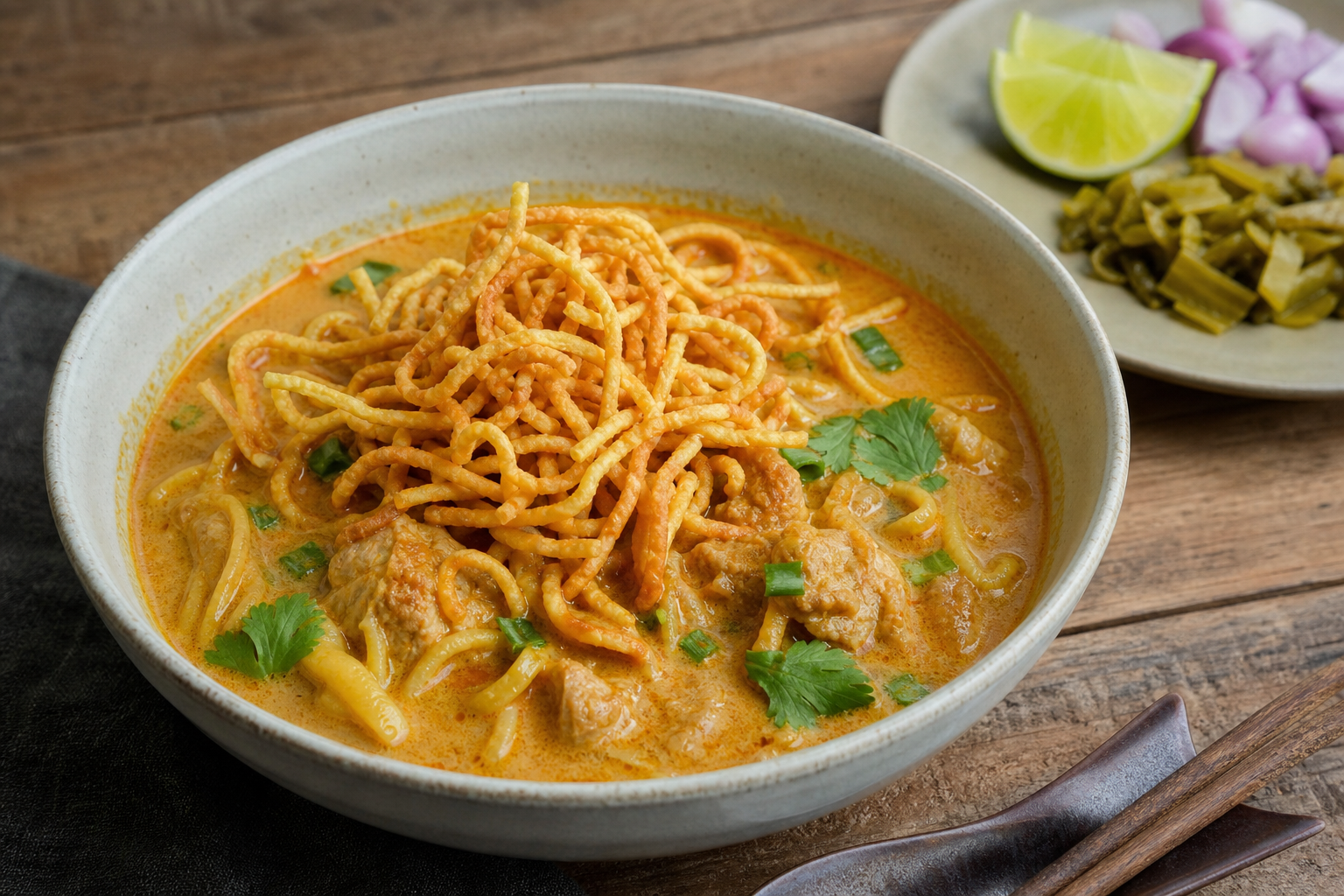
Khao soi is the dish to order: a curry noodle soup topped with a nest of crisp fried egg noodles, per Cozymeal, checked August 2026. It carries the same Burmese heritage as the region's cooking generally. Eaten properly it is a mess — you break the crisp noodles into the soup and they soften as you go.
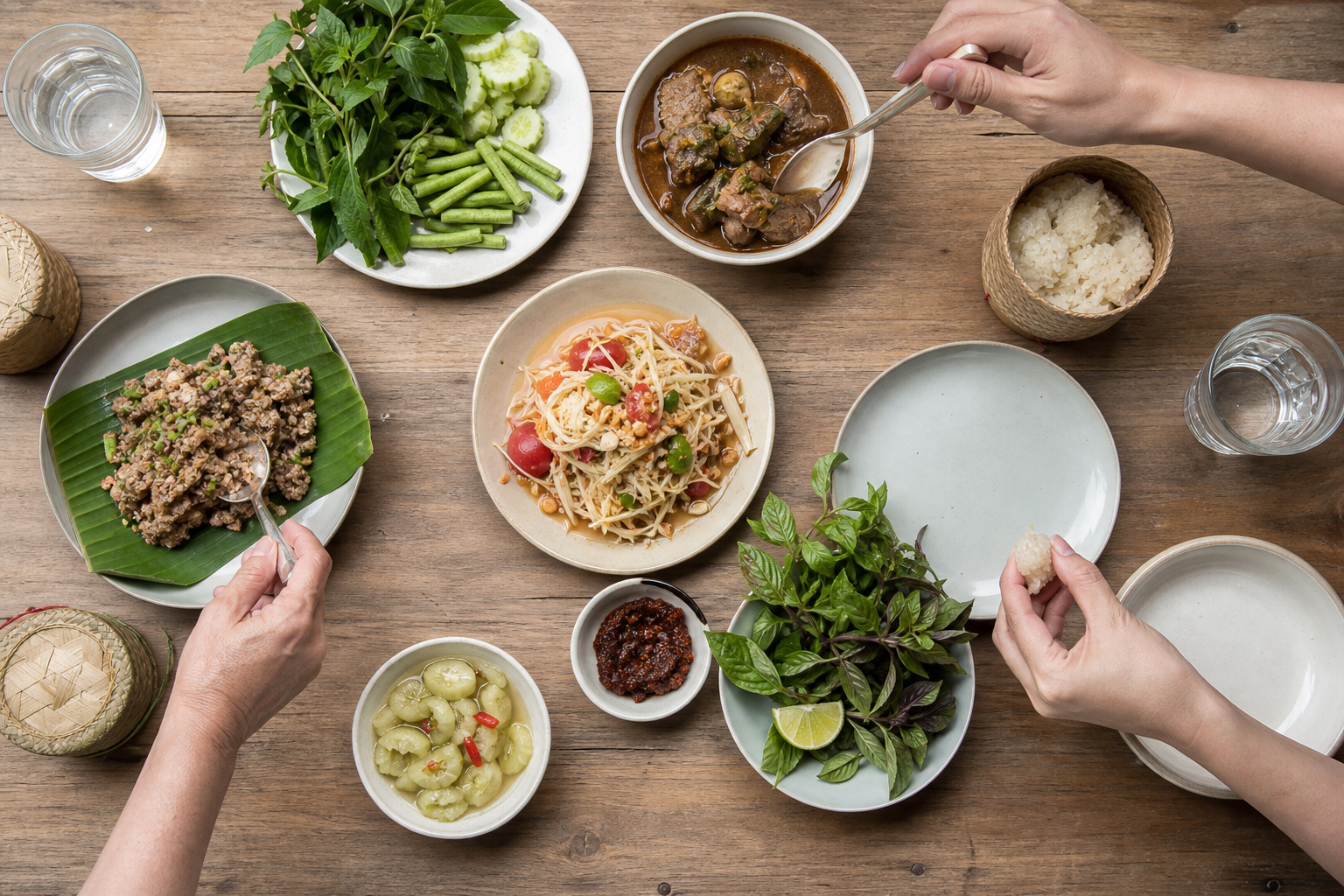
The North also eats sticky rice, khao niao, and eats it with the hands rather than a fork. You take a small amount, roll it into a ball, and use it to pick up what is on the plate. Nobody expects a visitor to do this elegantly, and trying is better received than asking for a fork.
Chiang Mai holds 18 Bib Gourmand venues in the 2026 selection, three of them new, according to Nation Thailand, checked August 2026. The named newcomers there are Chavee, Ueang Kham Sai and Kong Kham, all Northern Thai. Thai romanisation varies, so search the MICHELIN Guide rather than the spelling.
Our Chiang Mai guide covers the city itself.
The North-east: sour, fierce and eaten with your hands
Isan food is the sour, fiery end of Thai cooking, and like the North it is built on sticky rice eaten by hand, per On Off Spices, checked August 2026. It is also the food you will meet most often outside its home region — Isan cooks work all over Thailand, and som tam stalls are everywhere.
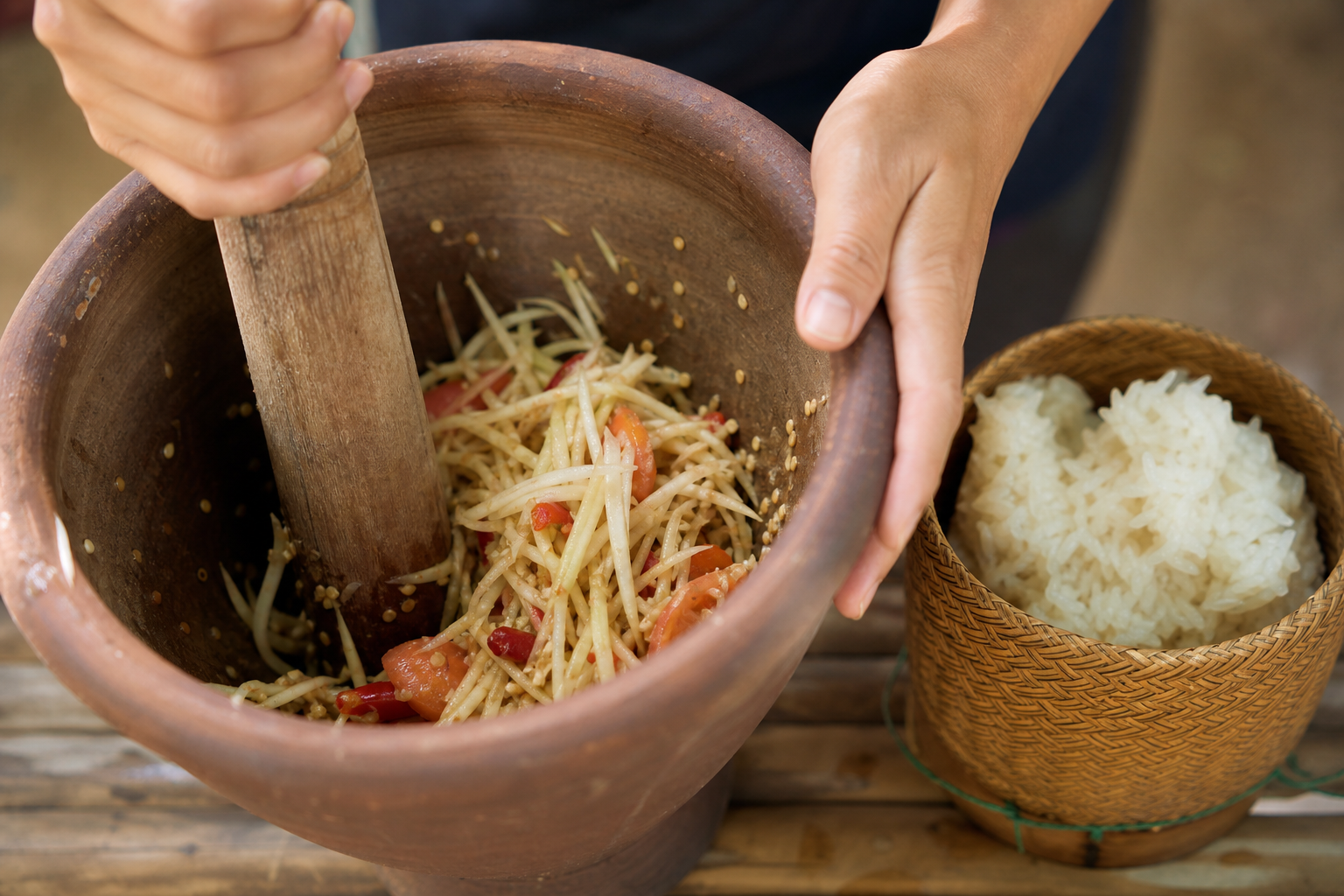
Som tam is shredded green papaya pounded with lime, fish sauce, chilli and palm sugar — spicy, sour and slightly sweet, per Thailand.go.th, checked August 2026. Its origins lie with Lao people, and it belongs to Isan rather than to Thailand generally.
Som tam is the dish where the heat question matters most. It is assembled to order in a mortar in front of you, which means the chilli count is a decision someone is making about you in real time. It is also the easiest dish in Thailand to adjust — say the word before they start pounding.
The 2026 Bib Gourmand selection covers 28 north-eastern venues across four cities: Khon Kaen 11, Nakhon Ratchasima 8 with one newcomer, Udon Thani 6 with one newcomer, and Ubon Ratchathani 3, per Nation Thailand, checked August 2026. The newcomers named are Nhab in Nakhon Ratchasima, a noodle place, and Pad Thai Bua Daeng in Udon Thani.
That is 28 recognised venues in a region almost no first-time itinerary includes. Worth knowing before you write the north-east off.
The Centre: the balance most people mean by Thai food
Central Thai cooking aims at balance — sweet, sour, salty and spicy holding each other in check rather than any one dominating, per On Off Spices and Simply Suwanee, checked August 2026. It is the cuisine of the royal court's refinement, and it is what most people outside Thailand picture when they think of Thai food.
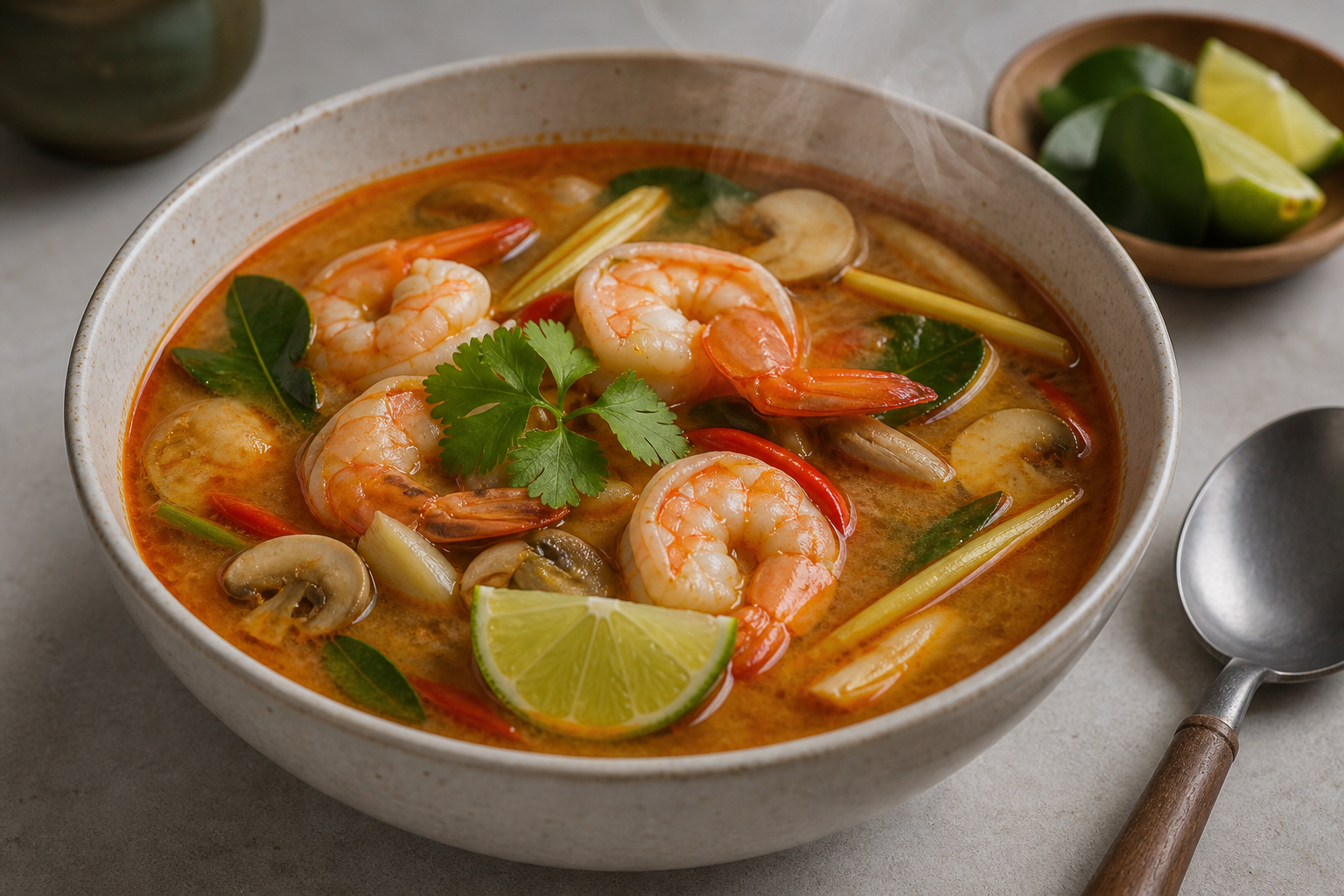
Tom yum is the dish to order here: a hot and sour soup, most often made with prawns as tom yum kung, per Thailand.go.th, checked August 2026. It is one of the few Thai dishes where the sourness is as prominent as the heat, and it is the clearest demonstration of what "balance" means in practice.
The Centre is also jasmine rice country — served on a plate, eaten with a spoon in the right hand and a fork in the left, the fork used to push food onto the spoon rather than to lift it. Chopsticks come out for noodle dishes, not for rice.
Bangkok and its surroundings hold 44 Bib Gourmand venues in 2026, four of them new, per Nation Thailand, checked August 2026 — Jan by Khun Jim, serving Southern Thai and Thai-Chinese; Kaew Loon; Ko Loon, Hainanese; and Sann, cooking Phetchaburi food. Ayutthaya adds eight, with Mae Yai Thai Custard new in the 2026 edition.
For eating in Bangkok specifically, our Old Town itinerary pairs central Thai food with the temples, the Yaowarat night food walk covers Thai-Chinese cooking after dark, and the Chatuchak guide handles the weekend.
The South: coconut, and the real heat
Southern Thai food is the hottest in the country, built on coconut milk, and shaped by the Muslim communities of the region, per On Off Spices and Simply Suwanee, checked August 2026. If you have been comfortable with heat elsewhere in Thailand, the south is where that gets tested.
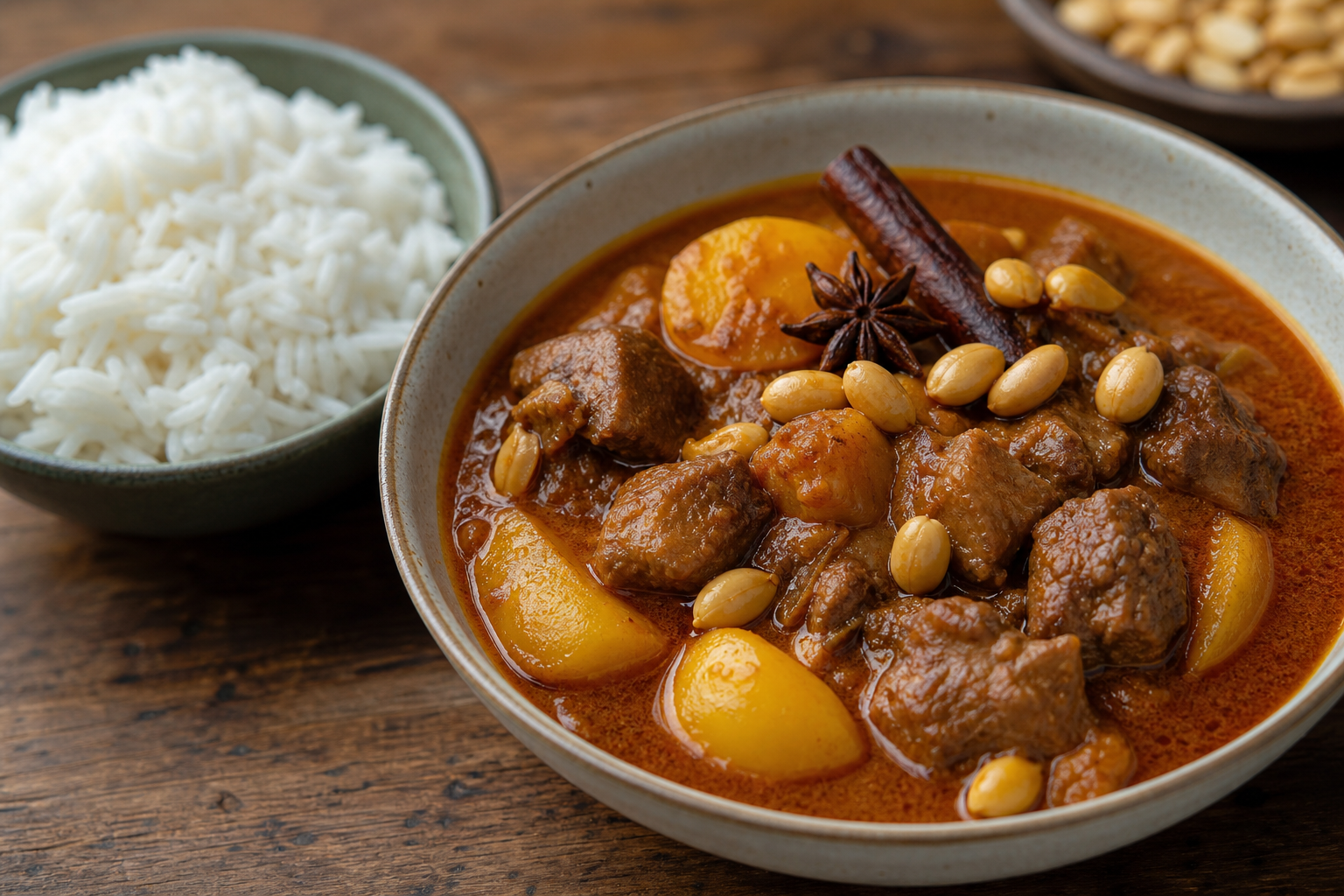
Massaman is the exception and the place to start: a rich, slow-cooked curry with Persian and Indian ancestry that entered Thai cooking through those same southern Muslim communities, per On Off Spices, checked August 2026. It is mild, sweet and spiced rather than chilli-hot — the least intimidating curry in Thailand and, not coincidentally, the one most often ordered by visitors who have been caught out once already.
Order massaman to enjoy the south. Order a southern curry that is not massaman to find out what the region actually thinks hot means.
The 2026 selection gives Phuket 19 venues, Surat Thani 7 with two new, and Phang-nga 6 with one new — Krachang Khao Lak, a seafood restaurant, per Nation Thailand, checked August 2026. Ko Samui has two and Chon Buri five.
Our Phuket beaches guide covers the island itself.
How does the MICHELIN Bib Gourmand list help you?
It solves the "where do I eat" problem without a guess. The MICHELIN Guide Thailand 2026 Bib Gourmand selection covers 137 venues, 13 of them first-time entries, spread across around fifteen cuisine categories from street stalls to sit-down restaurants, at roughly 1,000 baht for the equivalent of a three-course meal, according to Nation Thailand, checked August 2026.
The price threshold is what makes it useful. Bib Gourmand is explicitly the good-value distinction, not the aspirational one — these are places a normal traveller can walk into.
Two cautions. First, the selection is reissued every year, so check the current MICHELIN Guide Bib Gourmand list rather than an article about a past edition — including this one, in a year's time. Second, this site has not eaten at any of them. The names above are reported entries with their city and cuisine, nothing more.
How does a Thai meal actually work?
Dishes arrive when they are ready and are shared, not served in courses to one person. You order several things for the table, rice comes separately, and everyone takes small amounts onto their own plate rather than filling it once. Soup is not a starter — it sits alongside everything else.
Two practical consequences. Ordering one dish each, Western-style, gives you a worse meal than ordering four things between three people. And if your food arrives one plate at a time with gaps, nothing has gone wrong.
Condiments on the table — dried chilli, chilli in vinegar, fish sauce, sugar — are there for you to adjust the dish yourself. That is expected, not a criticism of the cook.
Practical tips
- Start north, move south if you are nervous about heat. It is the gentlest possible calibration curve.
- Eat where it is busy. Turnover is the single best proxy for both quality and freshness.
- Order som tam before it is pounded, not after — the chilli decision happens in the mortar.
- Fish sauce, shrimp paste and peanuts are everywhere. If you have an allergy, this needs proper planning rather than a phrase learned on arrival.
- The fork pushes, the spoon lifts. Chopsticks are for noodles.
- Try the sticky rice by hand in the north and north-east. It is how the food is designed to be eaten.
- On entry rules: in July 2026 the Thai cabinet approved reducing visa-free stays to 30 days and trimming the eligible list to 59 countries and territories, according to TAT Newsroom. As of 2 August 2026 the change had not taken effect — it applies 15 days after publication in the Royal Gazette.
Frequently asked questions
Is Thai food too spicy for foreigners? Not inherently, but it varies by region. Southern Thai food is the hottest and Northern Lanna cooking the mildest, per On Off Spices, checked August 2026. Asking for less chilli is completely normal and cooks adjust routinely. Food made for a Thai audience is hotter than the tourist version, so calibrate with one dish before committing.
What should I eat first in Thailand? Pad Thai, tom yum, som tam, khao soi, green curry and mango sticky rice cover noodles, soup, salad, curry and dessert between them, and are the dishes foreign visitors most consistently look for per Cozymeal and Thailand.go.th, checked August 2026. Order them in the region each belongs to where you can.
Where does khao soi come from? Northern Thailand, with Burmese influence in its heritage, per On Off Spices, checked August 2026. It is a curry noodle soup topped with crisp fried egg noodles. Chiang Mai is where to eat it — the city holds 18 Bib Gourmand venues in the 2026 selection, three of them new.
What is the difference between Thai regions' food? Four traditions. The North is herbal and mildest, the North-east sour and fiery, the Centre balanced, the South hottest and coconut-rich. The North and North-east eat sticky rice by hand; the Centre and South eat jasmine rice with a spoon and fork. Per On Off Spices and Simply Suwanee, checked August 2026.
How do I know a restaurant is good in Thailand? Busy is the best everyday signal. For something more systematic, the MICHELIN Guide Thailand 2026 Bib Gourmand selection lists 137 good-value venues at around 1,000 baht for a three-course equivalent, per Nation Thailand, checked August 2026. It is reissued annually, so check the current edition.
Do I need to speak Thai to order food? No. In tourist-facing Thailand, English and pointing work. This guide deliberately does not teach you a Thai phrase for spice level — transliterations are inconsistent and a mangled one can land as rude rather than mild. "Not spicy" in English, with a gesture, is understood.
How is a Thai meal served? Everything is shared and arrives as it is ready, not in courses. Order several dishes for the table with rice separately, and take small amounts onto your own plate. Soup sits alongside rather than starting the meal. Table condiments are there for you to adjust the dish yourself.
Final thoughts
The single most useful shift for a first-time visitor is to stop thinking of "Thai food" as one thing. It is four cuisines that happen to share a country, and knowing which one you are standing in tells you what to order, how hot it will be, and whether to reach for a spoon or your hands.
Start in the north if heat worries you, eat som tam where it is made in front of you, and treat the Bib Gourmand list as a shortcut rather than a checklist. Then follow the food into the regions — our guides to Chiang Mai, Bangkok's Old Town and Phuket pick up where this leaves off.
Disclosure: This article may contain affiliate links. If you make a booking through one of these links, we may earn a commission at no additional cost to you.
Information last verified: 2 August 2026. The MICHELIN Bib Gourmand selection is reissued annually and restaurants change; confirm the current edition before planning meals around it.
Leave a Reply