Table of Contents
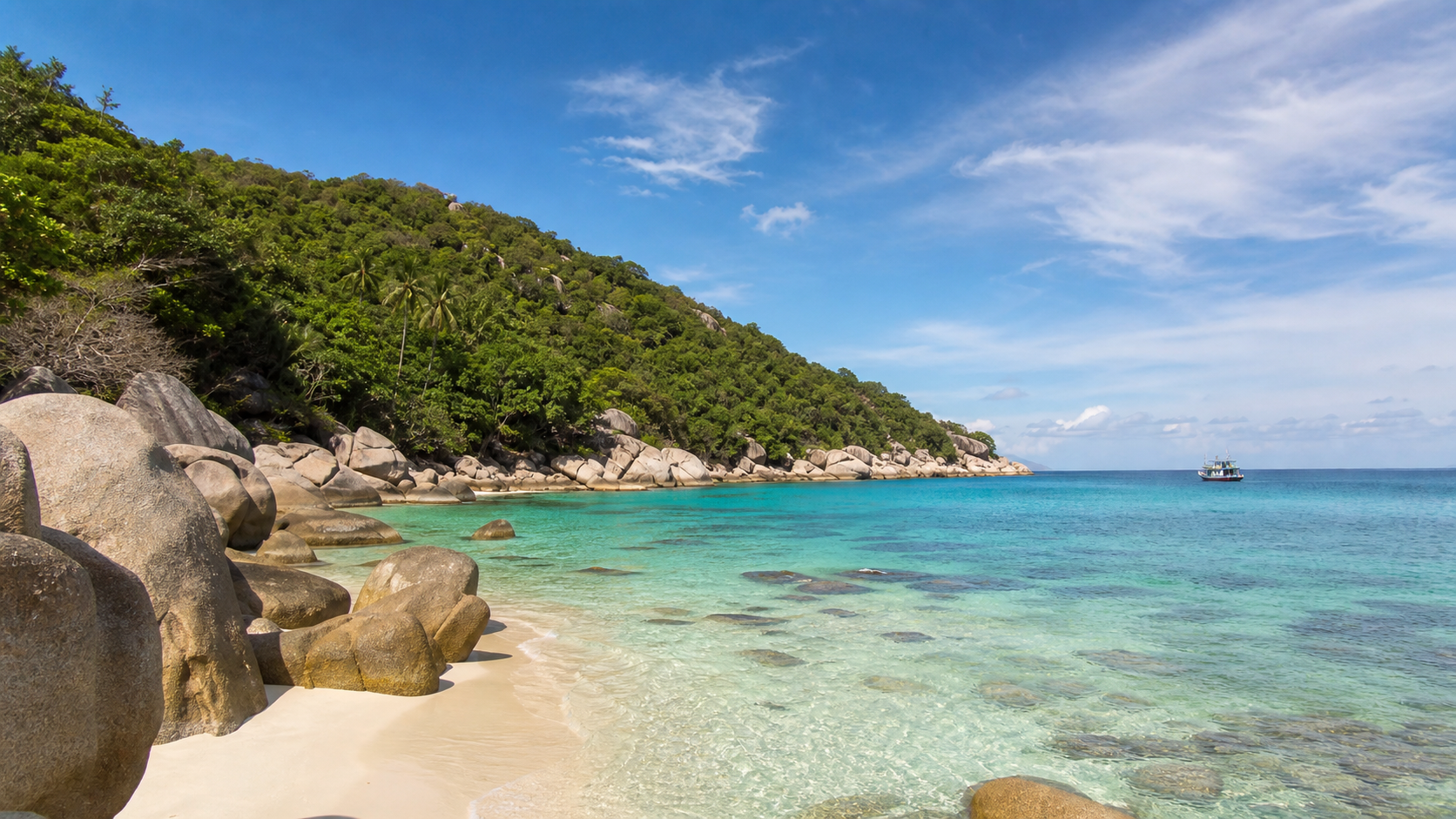
Koh Tao can work well for a first snorkeling or diving trip, but the right plan depends on swimming ability, medical readiness, sea conditions and operator checks—not a universally “best” bay. Koh Tao has no airport, so every visit also requires a ferry.
Choose among independent snorkeling, guided snorkeling, an introductory dive and an entry-level course before booking accommodation. Credentials, equipment, group size, the marine forecast and a workable departure plan matter more than a beachfront label.
Quick answers
- Best starting activity: Confident swimmers may consider snorkeling under suitable conditions; weak swimmers and anxious beginners should arrange guidance rather than treating equipment rental as sufficient preparation.
- Best time: No month guarantees calm water or visibility. Check the travel-date marine forecast and ask the operator which sites are appropriate that day.
- Useful bases: Mae Haad favors ferry and town convenience, Sairee offers a central activity base, and Chalok Baan Kao may suit travelers seeking a quieter southern location.
- Essential safety check: Verify the assigned professional, actual group size, equipment procedure, entry and exit plan, and emergency action plan before paying.
- Getting there: Reach Koh Tao through Chumphon, Surat Thani or Koh Samui, then complete the journey by ferry.
Koh Tao beginner key facts
| Decision point | Verified planning fact |
|---|---|
| Island access | Koh Tao has no airport; every arrival requires a ferry |
| Approximate ferry leg from Chumphon | About 90 minutes, according to the Koh Tao Tourism Association, checked July 2026; operator, vessel, sea state and schedule may change the journey |
| Approximate ferry leg from Surat Thani | About 3 hours with island stops, according to the Koh Tao Tourism Association, checked July 2026; confirm the actual pier and sailing |
| Approximate ferry leg from Koh Samui | About 2 hours, according to the Koh Tao Tourism Association, checked July 2026; confirm the booked route and connection |
| Introductory-dive supervision in coral areas | Legal maximum of 1 supervisor to 2 learners, according to the Tourism Authority of Thailand and Department of Marine and Coastal Resources, checked July 2026; a smaller group may suit a novice better |
| Snorkeling supervision in coral areas | Legal maximum of 1 supervisor to 20 participants, according to the Tourism Authority of Thailand and Department of Marine and Coastal Resources, checked July 2026; the maximum is not a recommendation for every beginner |
| PADI Open Water water assessment | 200-metre continuous swim or 300 metres with mask, fins and snorkel, plus a 10-minute float or tread, according to the Professional Association of Diving Instructors, checked July 2026 |
| Flying after one no-decompression dive | Divers Alert Network recommends at least 12 hours, checked July 2026; the interval reduces but does not eliminate risk |
| Flying after repeated dives | Divers Alert Network recommends at least 18 hours after multiple dives in one day or on multiple days, checked July 2026; longer intervals reduce risk further |
Should a beginner snorkel, try an introductory dive, or take a course?
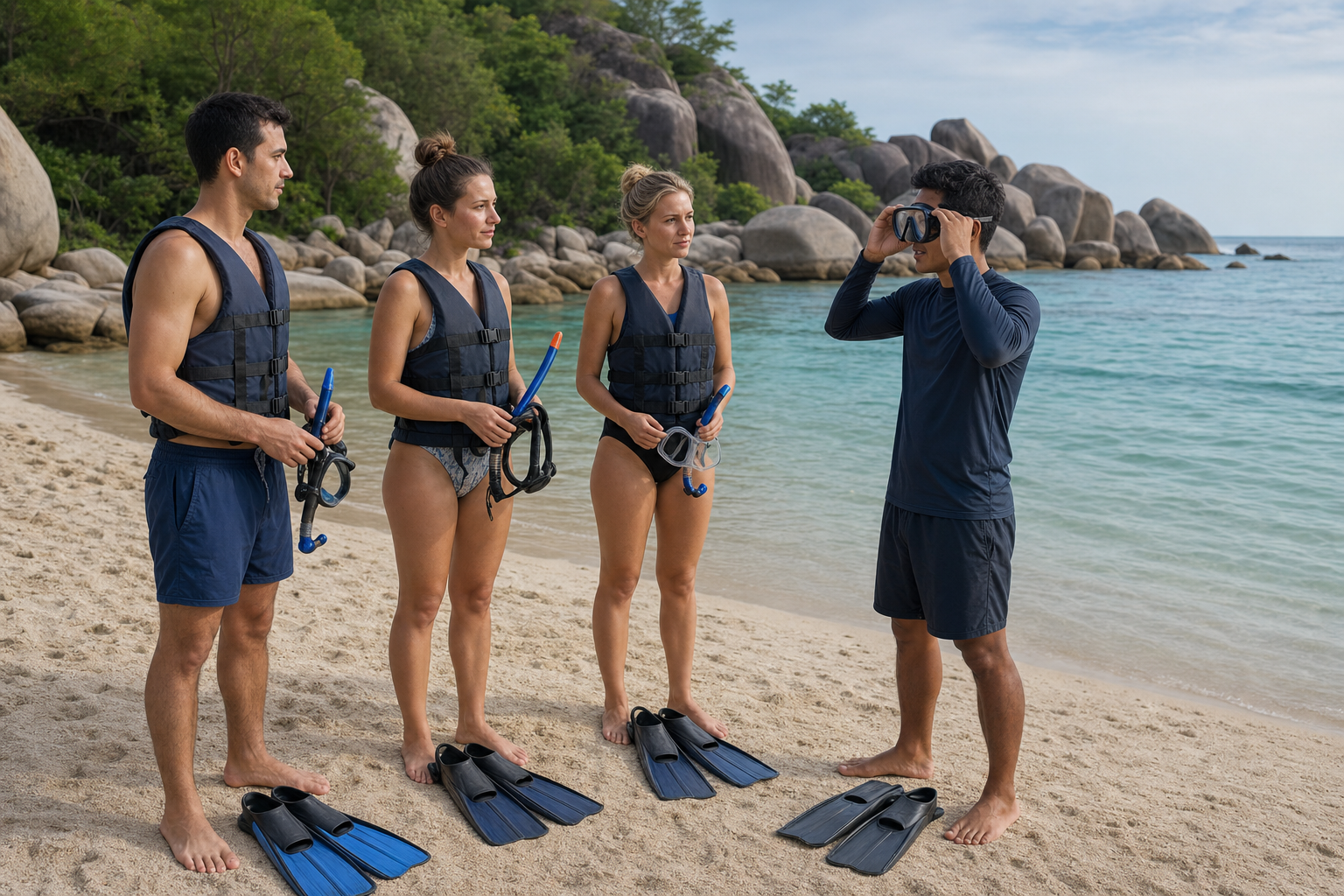
Choose snorkeling for a lower-commitment water experience, a guided session when swimming confidence or local knowledge is limited, an introductory dive to sample scuba under direct supervision, or certification when learning the full skill sequence is the main trip goal. Medical screening, available time and comfort in water should decide the choice.
Independent snorkeling
Independent snorkeling is not risk-free. Divers Alert Network identifies water inhalation, health events, watercraft, tides and currents among drowning factors. Consider it only when you can swim confidently, understand the equipment and have a local conditions assessment. Identify the exit, observe boat traffic and ask about current, tide and access.
Guided snorkeling
Guided snorkeling may better fit weak swimmers, anxious first-timers and families, but supervision cannot guarantee safety. Thailand’s coral-area rules require a briefing and certified supervision. The legal maximum is one supervisor to 20 snorkelers or freedivers, according to the Tourism Authority of Thailand and Department of Marine and Coastal Resources, checked July 2026; beginners may ask for a smaller group.
Near coral reefs, a life vest must be provided and worn unless the recognized-freediver exception applies. Disclose swimming ability honestly and do not enter merely because the group is going.
Introductory diving
An introductory dive offers supervised exposure without making certification the trip’s main goal. Ask what instruction, confined practice and in-water experience are included. Thailand’s legal maximum in coral areas is one supervisor to two introductory learners, according to the Tourism Authority of Thailand and Department of Marine and Coastal Resources, checked July 2026, but an anxious traveler may prefer one-to-one attention or guided snorkeling.
Entry-level certification
Professional Association of Diving Instructors (PADI) Open Water Diver training includes knowledge development, confined-water skills and four open-water dives. Completion is performance-based, not guaranteed by a fixed schedule. PADI requires a medical questionnaire; a flagged answer may require physician assessment before entering the water, according to PADI guidance checked July 2026.
PADI also lists a 200-metre swim, or 300 metres with mask, fins and snorkel, plus a 10-minute float or tread, checked July 2026. Other recognized agencies may differ. Request forms before travel if a medical answer may need review.
When is the best season for Koh Tao snorkeling and diving?
Koh Tao has broad seasonal patterns rather than a guaranteed best month. February through May is generally hottest, June through October can include windy days, and November or December through January is generally wettest. The travel-date Thai Meteorological Department marine forecast and the operator’s local assessment should override every seasonal average.
Seasonal descriptions cannot promise calm seas, visibility, access or wildlife. Check the Thai Meteorological Department shipping forecast shortly before travel and before the activity; waves can increase in thundershowers. Keep time for a site change, delay or non-water day.
Which Koh Tao bays should beginners consider?
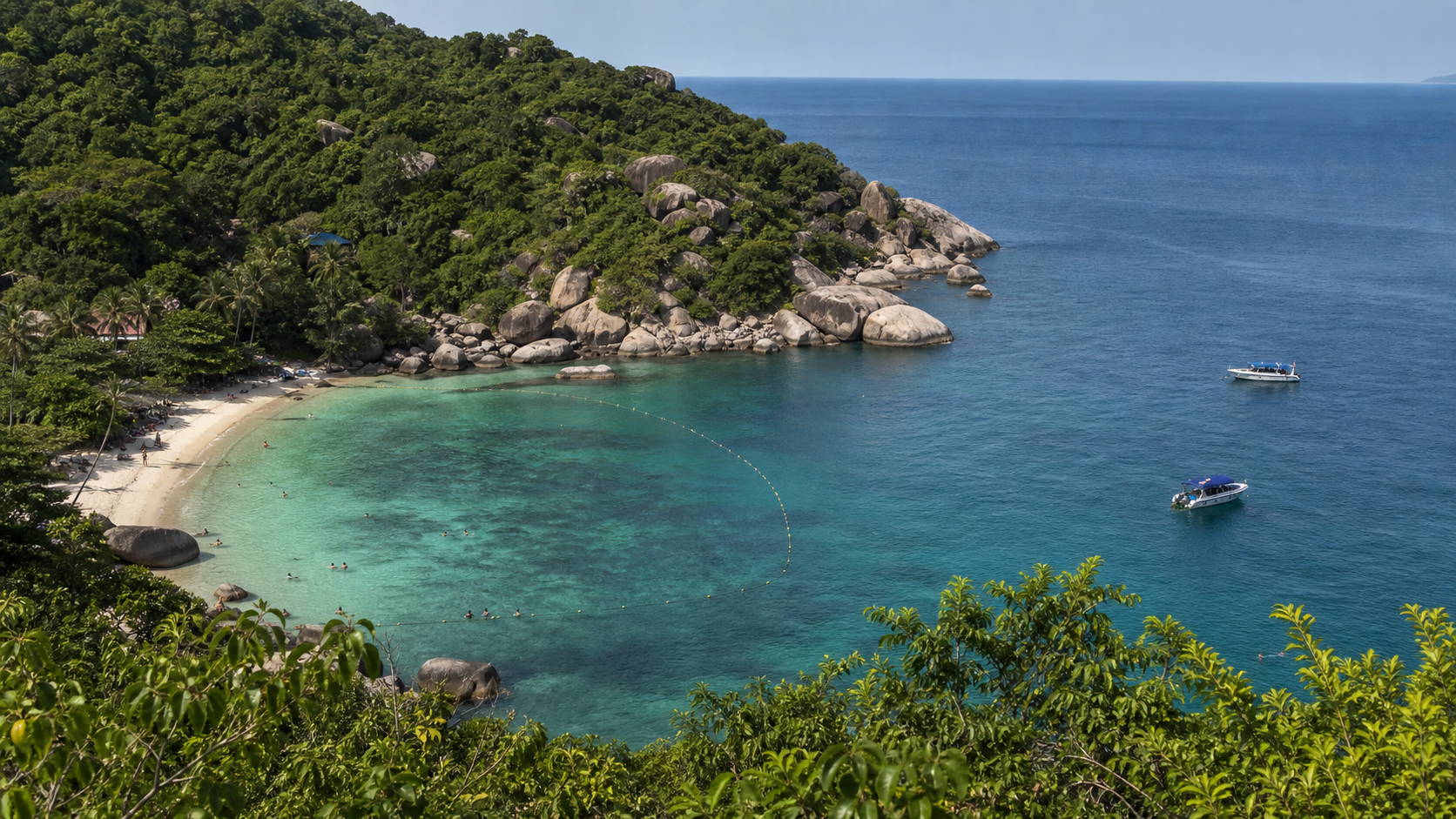
Mae Haad Bay, Shark Bay (Thian Og), Mango Bay, Sai Daeng Beach and Sai Nuan Beach are recognized snorkeling locations, while Tanote Bay and Aow Leuk Bay are popular beaches. Every choice remains conditional on wind, waves, current, tide, access, boat traffic and the swimmer’s ability on the actual day.
Mae Haad Bay
Mae Haad Bay is the arrival area and an accommodation base, but convenience does not establish water suitability. Ask locally which part, if any, is appropriate and consider boat movement and exit conditions.
Tanote Bay and Aow Leuk Bay
Tanote Bay is an established snorkeling destination, while Aow Leuk Bay is a popular beach. Either may be a candidate under suitable conditions, never a guaranteed calm or clear-water choice. Families and older travelers should confirm access; some island beaches require a longtail boat or hike.
Shark Bay, Sai Daeng and Sai Nuan
The Koh Tao Tourism Association identifies Shark Bay, Sai Daeng Beach and Sai Nuan Beach as snorkeling locations, not a safety ranking. Ask which side suits the wind and how boat traffic affects entry. Turtles, reef sharks and whale sharks cannot be promised.
Mango Bay and remote access
Mango Bay is another recognized snorkeling location, but remote beaches may require a longtail boat or hike. Confirm return arrangements and access for children or limited mobility. Some beaches may charge for access, so check locally.
How should you choose a snorkeling or diving operator?
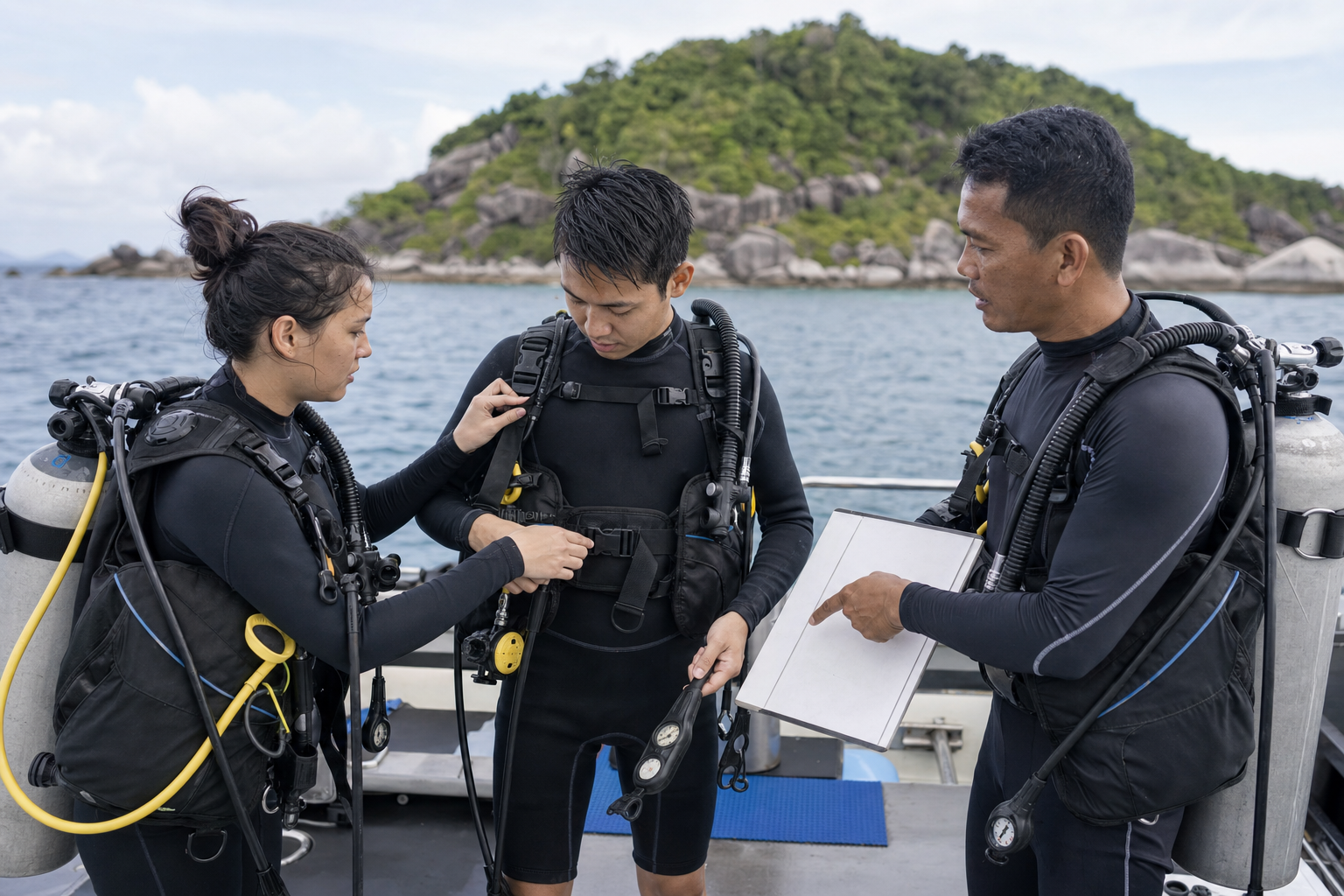
Choose a Koh Tao operator by checking the assigned professional, group size, briefing, equipment process, entry and exit plan, boat procedure and emergency action plan. A training-agency logo or directory listing confirms neither the suitability of the individual instructor nor the quality of the actual group, equipment, vessel or response arrangements.
Before paying, ask these questions:
- Who will be the assigned instructor or supervisor, and can the credential be checked?
- What is the actual participant-to-professional ratio for my session?
- Where will initial skills be practiced, and what happens if I cannot complete them comfortably?
- How is rental equipment fitted, inspected and replaced if a problem appears?
- What are the planned entry and exit methods for the selected site?
- What marine conditions would cause the operator to change the site or cancel?
- What emergency action plan applies, and how will the group communicate on the boat?
- Which medical form must I complete, and when might physician assessment be required?
The Professional Association of Diving Instructors (PADI) Pro Chek service verifies an individual PADI member’s standing, and PADI publishes consumer alerts, according to PADI guidance checked July 2026. Divers Alert Network also recommends an equipment check, pre-dive checklist, agreed buddy or divemaster plan, confirmed entry and exit procedures, and an emergency action plan. Repeat these checks before boarding.
What rules protect Koh Tao’s coral areas?
Thailand’s nationwide coral-protection measures took effect on 22 April 2025 for five years and cover snorkeling and diving around coral reefs. The rules require briefings and certified supervision, set maximum participant ratios, govern life-vest and camera use, and prohibit damaging conduct, according to the Tourism Authority of Thailand and Department of Marine and Coastal Resources, checked July 2026.
Do not touch or stand on coral or marine life, feed animals, litter, disturb sediment or join Sea Walker-style seabed walking. Cameras are restricted during training dives; recreational camera divers must meet the stated qualification or logged-dive threshold.
Where should beginners stay on Koh Tao?
Stay in Mae Haad for ferry and town convenience, Sairee Beach for a central activity-oriented base, or Chalok Baan Kao for a quieter southern setting. Accommodation choice should follow the actual training location, pickup arrangement, mobility needs and evening preference—not a claim that one area has permanently better water or safer access.
| Base | May suit | Main limitation to check |
|---|---|---|
| Mae Haad | Short stays, ferry logistics and travelers prioritizing nearby town services | Confirm transfer needs between accommodation and the chosen activity |
| Sairee Beach | Travelers wanting a central beach base or integrated dive-resort setup | Confirm room position if sensitive to noise; verify the assigned instructor separately |
| Chalok Baan Kao | Travelers seeking a quieter southern base, hostel choice or accommodation attached to diving | Confirm slopes, stairs, room access and transfers |
Mae Haad: practical for ferry logistics
Ananda Villa may suit travelers prioritizing a family-managed base near Mae Haad town services. Rooms and bungalows were operating according to the Ananda Villa official website, checked July 2026. Confirm availability and activity transfers.
Sensi Paradise Beach Resort may suit travelers seeking resort-style accommodation. Houses, suites and beach-bungalow categories were operating according to the Sensi Paradise Beach Resort official website, checked July 2026. Verify the exact room and access.
Sairee Beach: central and activity-oriented
Sairee Cottage Resort may suit travelers wanting a family-run beachfront base with a pool and dining. The property was operating according to the Sairee Cottage Resort official website, checked July 2026. Noise-sensitive guests should ask about room position.
Ban’s Diving Resort combines accommodation, dining, pools and diving. The property was operating according to the Ban’s Diving Resort official website, checked July 2026, but verify the assigned professional, group, equipment, boat and emergency plan separately.
The Tarna Resort offers a hillside base near Sairee Bay. Rooms, dining, pool and shuttle information were active according to The Tarna Resort official website, checked July 2026. Confirm shuttle times and slope access.
Chalok Baan Kao: quieter southern choices
View Point Resort may suit a quieter Chalok Baan Kao stay. Cottages, villas, a pool and dining were operating according to the View Point Resort official website, checked July 2026. Confirm slopes, room access and transfers.
The Dearly Koh Tao Hostel may suit budget and social travelers. Shared and private rooms were operating according to The Dearly Koh Tao Hostel official website, checked July 2026. The property states that some rooms are upstairs and there is no elevator, so confirm access.
Assava Dive Resort connects accommodation with diving services in Chalok Baan Kao. Its Professional Association of Diving Instructors directory listing was active when checked July 2026, but independently check the instructor, group, equipment, boat and emergency plan.
How do you get to Koh Tao without missing a connection?
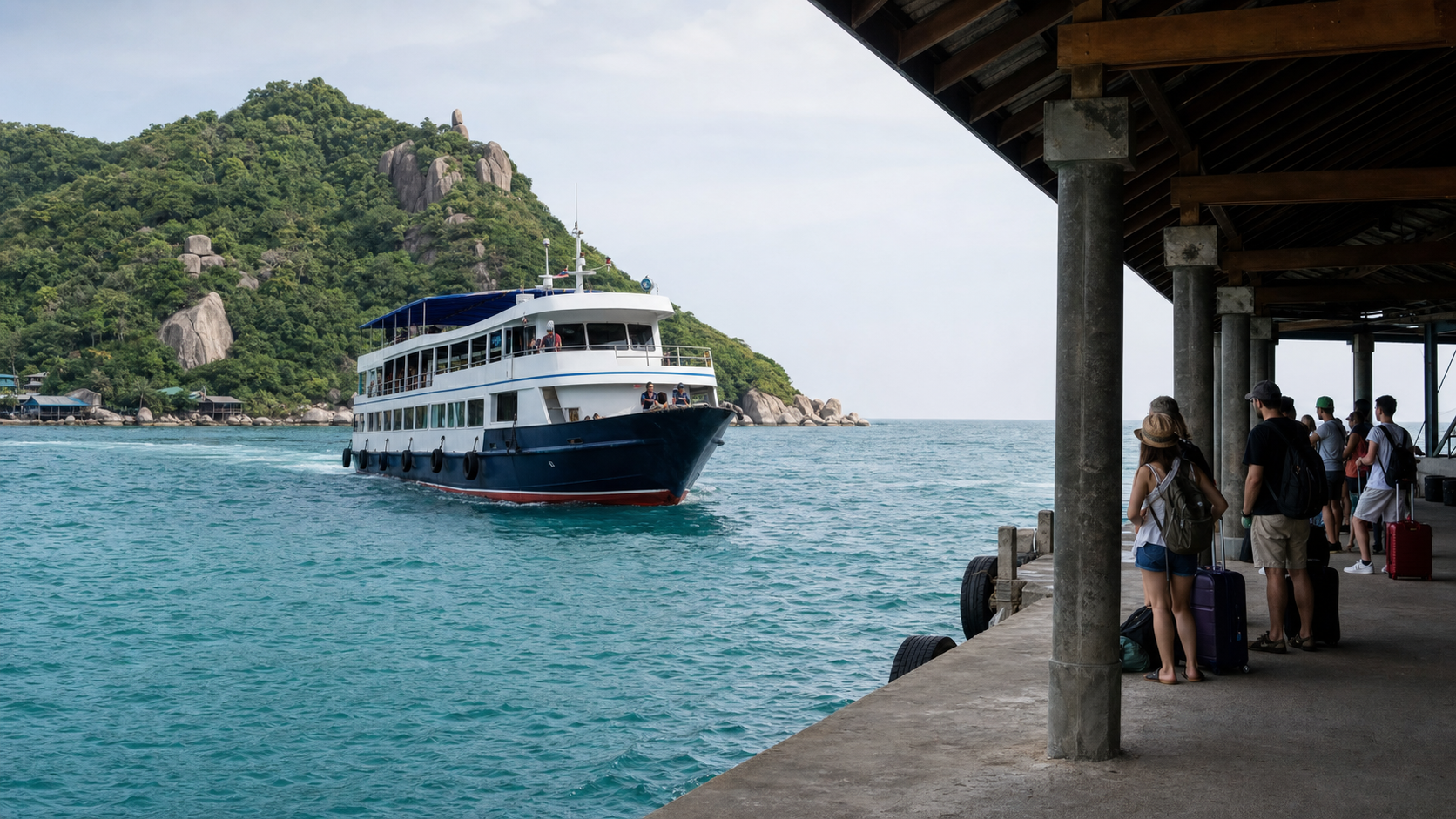
Reach Koh Tao through Chumphon, Surat Thani or Koh Samui, then take a ferry because the island has no airport. Approximate ferry legs are 90 minutes, three hours and two hours respectively, but the booked vessel, pier, stops, sea state and timetable can change both timing and connection risk.
The Koh Tao Tourism Association and Lomprayah High Speed Ferries network were checked in July 2026. Match the arrival to the exact pier, sailing, check-in and transfer before buying separate tickets. Leave enough connection buffer.
For another Gulf base, see Koh Samui for First-Time Visitors: Which Beach Area to Base Yourself On. For a mainland nature extension, see Khao Sok and Cheow Lan Lake for First-Time Visitors. For a different beach-area comparison, read Best Beaches in Phuket for First-Time Visitors.
How should food, rest and flying fit around diving?
Plan meals, rest and onward travel around the water schedule rather than treating dive sessions as movable gaps. Koh Tao accommodation with nearby town services or on-site dining can simplify logistics, but menus and hours can change. Avoid a tight connection after the final dive.
Choose food by proximity and timing, and confirm dietary requirements directly rather than assuming a hotel or restaurant can meet them.
Flying after diving requires special planning. Divers Alert Network recommends at least 12 hours before flying after one no-decompression dive, at least 18 hours after multiple dives in a day or diving on multiple days, and at least 24 hours after a dive requiring mandatory decompression, according to guidance checked July 2026.
Those minimums reduce but do not eliminate decompression-sickness risk; longer intervals reduce risk further. Plan the final dive, ferry and flight separately.
What can non-swimmers and bad-weather visitors do instead?
Non-swimmers should not treat a life vest or equipment rental as sufficient preparation, and bad sea conditions should not be negotiated away. Choose a guided activity only after honest ability screening, or stay ashore. A flexible Koh Tao day can prioritize rest, food, accommodation facilities and trip planning without entering the water.
Families and older travelers should consider access before selecting a bay. Some beaches require a longtail boat or hike, while slopes and stairs affect accommodation. If no site matches the conditions and traveler’s ability, postpone the activity.
A practical beginner booking sequence
- Choose the activity. Match swimming ability, medical readiness and available time to snorkeling, an introductory dive or certification.
- Request the forms. Obtain the operator’s medical questionnaire and participation requirements before committing to transport.
- Verify the professional. Check the assigned person’s credential through the relevant training agency.
- Ask for the ratio. Compare the actual group with Thailand’s legal maximum and request a smaller group if needed.
- Check the plan. Ask about equipment, briefing, skill practice, entry, exit, site changes and emergency response.
- Select the base. Compare Mae Haad, Sairee Beach and Chalok Baan Kao by pickup, mobility, dining and evenings.
- Recheck the sea. Use the travel-date Thai Meteorological Department marine forecast and accept a go/no-go or site change.
- Protect the departure. Leave buffer and observe the appropriate flying-after-diving interval.
Frequently asked questions
Is Koh Tao suitable for someone who has never snorkeled?
Koh Tao may suit a first snorkeling experience when conditions, supervision and the traveler’s ability align. Equipment rental alone is not enough preparation for every beginner. Weak swimmers, anxious visitors and families should consider guidance, disclose ability honestly, wear required safety equipment in coral areas and be willing to stay ashore when conditions are unsuitable.
Which Koh Tao bay is safest for beginners?
No Koh Tao bay has a verified day-independent “safest” classification. Mae Haad, Shark Bay, Mango Bay, Sai Daeng and Sai Nuan are recognized snorkeling locations, while Tanote and Aow Leuk are popular beaches. Suitability depends on the day’s wind, waves, current, tide, access, boat traffic and the individual’s swimming ability.
Can I fly directly to Koh Tao?
Koh Tao has no airport, so every traveler completes the journey by ferry. Common approaches use Chumphon, Surat Thani or Koh Samui. Match the actual airport or ground arrival with the correct pier and sailing before purchase, and leave buffer because schedules and sea conditions can affect connections.
How long should I allow between diving and flying?
Divers Alert Network recommends minimum preflight surface intervals of 12 hours after one no-decompression dive, 18 hours after multiple dives in a day or on multiple days, and 24 hours after a dive requiring mandatory decompression, according to guidance checked July 2026. The minimums reduce but do not eliminate risk; longer intervals reduce risk further.
Do I need to be a strong swimmer for an Open Water course?
The Professional Association of Diving Instructors (PADI) requires Open Water students to complete a 200-metre continuous swim or a 300-metre swim with mask, fins and snorkel, plus a 10-minute float or tread, according to guidance checked July 2026. Those requirements are specific to PADI. Ask the chosen recognized training agency for its current standards and do not conceal a limitation from the instructor.
How can I check a Koh Tao diving professional?
Ask for the name and credential of the professional actually assigned to the session. The Professional Association of Diving Instructors (PADI) Pro Chek service can verify an individual PADI member’s current standing, and PADI publishes consumer alerts, according to guidance checked July 2026. Credential checks should be combined with questions about the real group size, equipment, boat, entry and exit plan, and emergency action plan.
What should I do if the sea is rough?
Follow the travel-date Thai Meteorological Department marine forecast and the local go/no-go assessment. A responsible change may mean another appropriate site, a delay or no water activity. Do not treat seasonal averages, a prepaid plan or another group’s decision as proof that the conditions match your ability.
Final planning advice
The strongest Koh Tao plan starts with honest ability and medical screening, continues with operator and equipment checks, and keeps the forecast and return connection flexible. Choose accommodation for logistics rather than promises of perfect water, and be prepared to change or skip the activity.
Disclosure: This article may contain affiliate links. If you make a booking through one of these links, we may earn a commission at no additional cost to you.
Information last verified: 30 July 2026. Hotel prices, availability, opening hours, ferry schedules, marine conditions, access arrangements, regulations and operator details may change.
Leave a Reply