Table of Contents
Choosing a Phuket beach is really choosing a holiday style. Patong puts nightlife and services close at hand, Kamala offers a quieter resort-town rhythm, Karon gives you a long open shoreline, Kata balances facilities with a compact beach area, and the southern coves feel more removed. The best beaches in Phuket for first-time visitors therefore depend less on one universal ranking and more on atmosphere, transport, accommodation, and what the sea is doing that day.
This guide compares eight beaches from north to south: Nai Yang, Kamala, Surin, Patong, Karon, Kata, Nai Harn, and Ya Nui. It also explains how to read seasonal advice, where Rawai fits into a seafood plan, and which Phuket dishes are worth looking for.
Disclosure: This article may contain affiliate links. If you make a booking through one of these links, we may earn a commission at no additional cost to you.
Information last verified: July 20, 2026. Weather, waves, currents, beach flags, lifeguard coverage, transport, water activities, hotel availability, and food businesses can change. A beach described as suitable for swimming in general may be unsafe on a particular day.
Quick comparison: which Phuket beach fits your trip?
| Beach | General atmosphere | Swimming decision | Family fit | Nightlife | Transport and accommodation |
|---|---|---|---|---|---|
| Nai Yang | Shaded, relaxed, airport-adjacent | Enter only when flags and local conditions permit | Good for a low-key first or last night | Very quiet | Convenient for the airport; smaller beach-area lodging |
| Kamala | Quieter resort town with useful services | Conditional on daily flags and lifeguard advice | Often a practical family base | Low to moderate | Smart Bus corridor; varied accommodation |
| Surin | Scenic, compact, less urban | Avoid during unsafe monsoon conditions | Better for a short beach visit than an activity-packed base | Low | Smart Bus access; accommodation is more dispersed |
| Patong | Busy, commercial, highly developed | Use only designated, permitted areas | Convenient but intense | Phuket’s strongest nightlife concentration | Easiest service base; extensive accommodation |
| Karon | Long, open, more spread out | Check flags carefully, especially in rough weather | Space can suit families who remain cautious | Moderate | Smart Bus corridor; many lodging choices |
| Kata | Compact tourist area with shops and activities | Conditional; surf and current patterns change seasonally | Popular practical base, not a safety guarantee | Moderate | Smart Bus corridor; broad accommodation mix |
| Nai Harn | Green southern setting with lagoon behind | Phuket Province advises against swimming May-October due to strong currents | Pleasant for land-based family time when water is unsafe | Low | Private transport is often simpler; quieter lodging nearby |
| Ya Nui | Tiny cove with a small-scale feel | Never assume the cove is calm; obey flags and closures | Limited space and facilities | Very low | Best reached from Nai Harn or Rawai; limited immediate lodging |
Do not try to visit all eight in one day. Phuket is large, coastal roads can be slow, and a beach becomes more enjoyable when you have time to check conditions, settle in, eat, and leave before fatigue affects your decisions.
The safety rule that overrides every recommendation
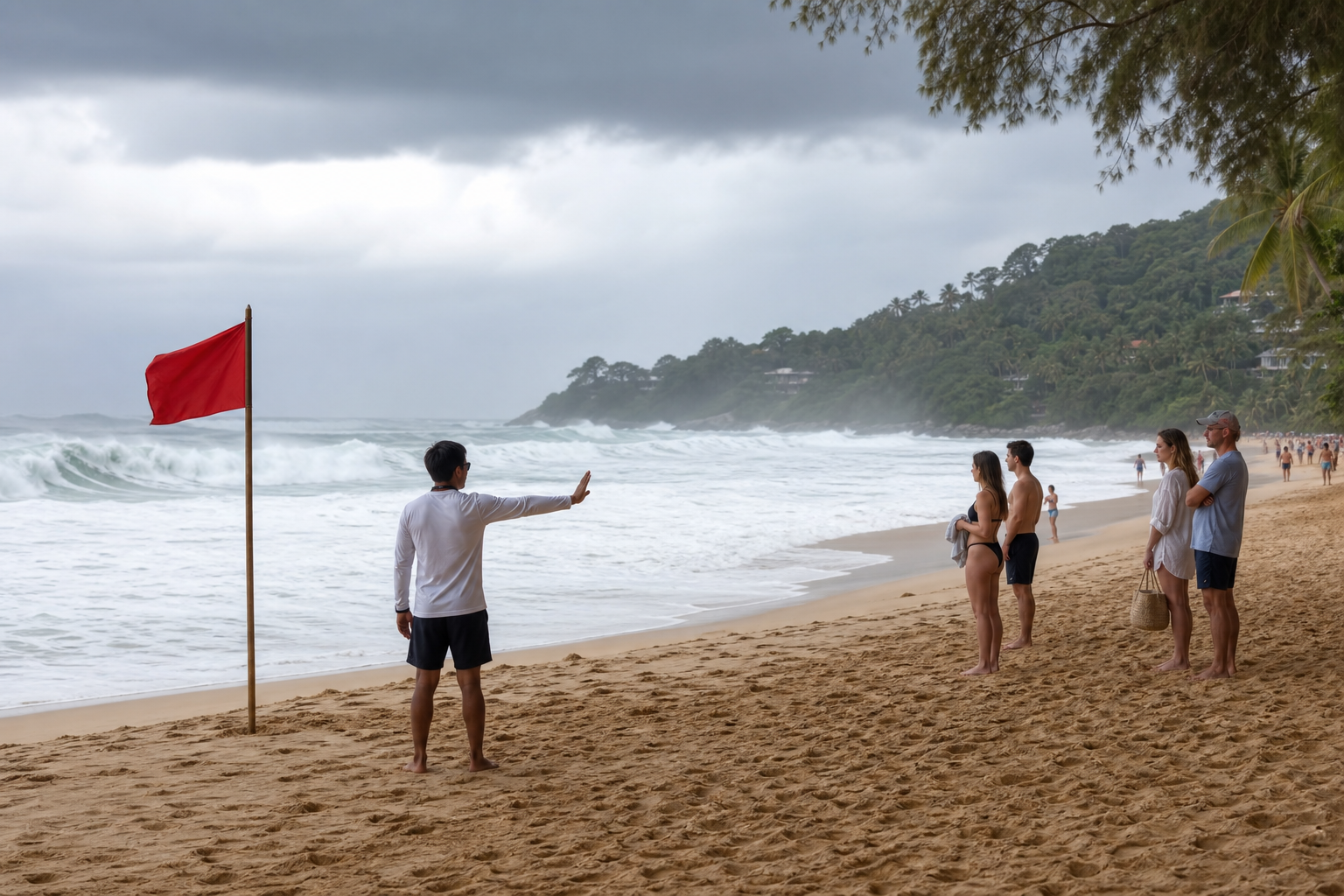
The sea decides whether you swim—not this article, a hotel description, yesterday’s weather, or how calm the water looks from the road.
Tourism Authority of Thailand monsoon guidance tells visitors to obey beach flags and lifeguards. A red flag means do not enter the water. Under that guidance, red-and-yellow flags mark a lifeguard-supervised swimming zone, but you should still ask the lifeguard about current conditions and remain within the marked area. Flag systems and staffing can vary, so a lack of visible flags is not proof of safety.
Before leaving your accommodation, check the Thai Meteorological Department Marine Meteorological Center and the Southern-West Coast marine forecast. On arrival, reassess the beach itself:
- Obey red flags, closure notices, barriers, and verbal instructions.
- Ask a lifeguard where entry is permitted; do not swim outside a designated zone.
- Stay out when waves are rough, visibility is poor, thunder is nearby, or you are unsure.
- Keep children within arm’s reach around water, even in shallow-looking areas.
- Do not use alcohol before swimming, snorkeling, surfing, kayaking, or operating equipment.
- Never chase an inflatable, phone, or other object into rough water.
The broad southwest-monsoon period commonly affects Phuket’s west coast from roughly May through October. That is a planning pattern, not a daily forecast. Calm-looking minutes can alternate with dangerous sets, rip currents, lightning, or marine-life warnings. November through April often brings more favorable beach weather, but it does not guarantee safe water.
Thailand’s Department of Marine and Coastal Resources also issues alerts for hazards such as venomous jellyfish and related marine organisms. Do not touch unfamiliar animals on the sand or in the water. Follow any temporary no-water notice and use the first-aid instructions posted at that beach rather than improvising.
1. Nai Yang Beach: the easiest relaxed start or finish
Nai Yang sits near Phuket International Airport, making it useful for travelers who do not want a long transfer immediately after landing or before an early flight. Phuket Province describes casuarina trees, picnic-friendly shade, and swimming and snorkeling opportunities. Those general descriptions do not replace a same-day sea check.
The atmosphere is more relaxed than Phuket’s major west-coast resort centers, suiting travelers who prioritize convenience and quiet over nightlife.
For swimming, inspect flags and ask locally. Nai Yang’s coastal setting can change with tide, wind, and season. Avoid coral contact, do not pursue turtles, and never treat wildlife references as a promise of a sighting.
Accommodation is generally smaller-scale than Patong’s inventory. Confirm whether a property is genuinely walkable to the beach; “near the airport” does not mean “on the sand.”
Best for: first or last night, airport convenience, shade, quiet evenings.
Less suitable for: travelers who want dense nightlife and nonstop entertainment.
2. Kamala Beach: a calmer resort-town compromise
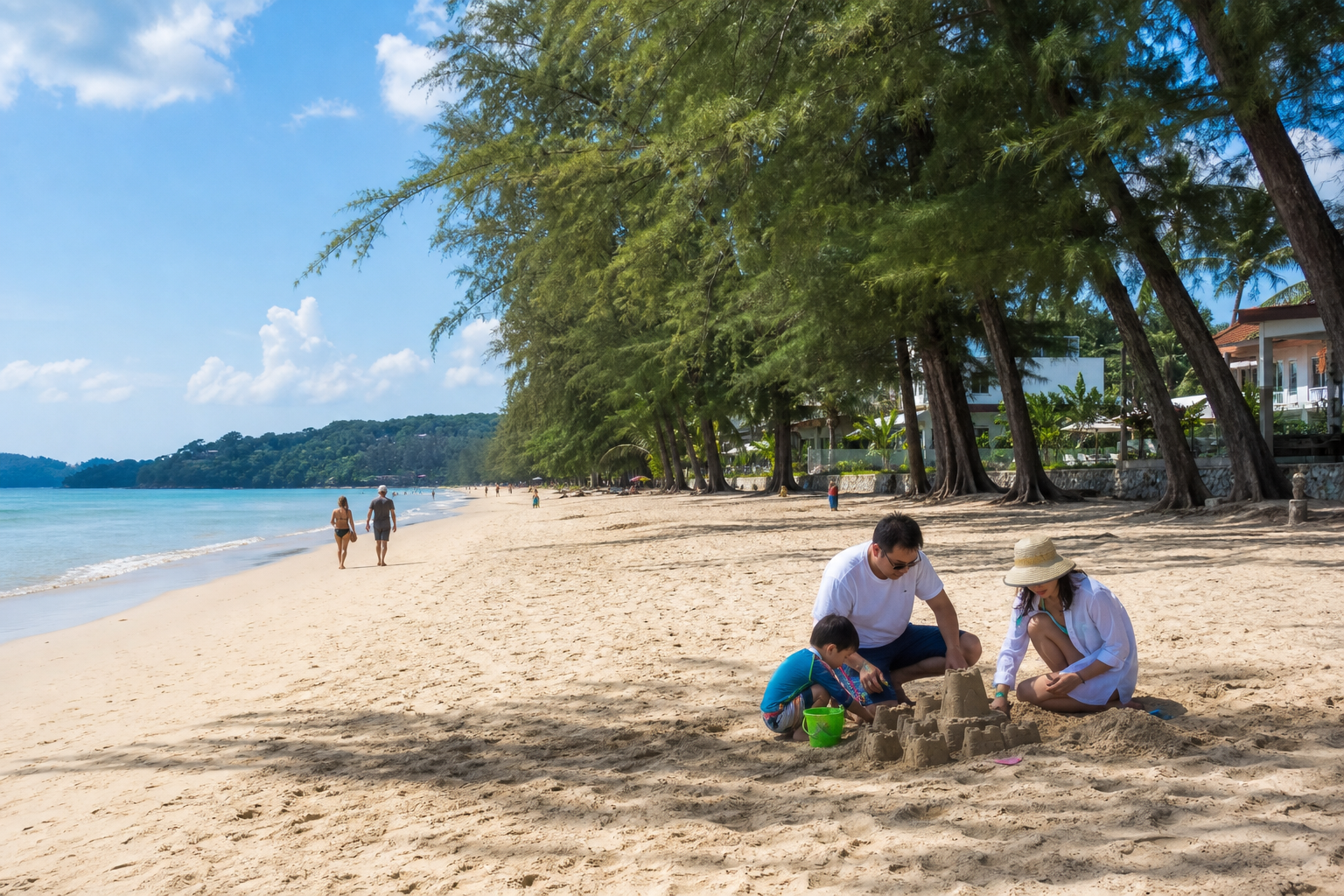
Phuket Province describes Kamala as a roughly two-kilometer beach with a quieter atmosphere plus hotels, bungalows, restaurants, shops, tour services, and other visitor facilities. That mix makes it a useful middle ground: calmer than Patong, but easier for a first-time visitor than an isolated cove.
Families may appreciate having food and accommodation within the same general district. The important distinction is that “family-friendly area” describes convenience, not water safety. Parents must still evaluate flags, waves, currents, and lifeguard guidance every time.
Kamala’s evening scene is subdued compared with Patong. Patong is reachable by road, though traffic makes trip times unpredictable.
Kamala lies on the Phuket Smart Bus airport-to-Rawai corridor. Check the current stop, direction, and live timetable before relying on it. A hotel farther inland or at the edge of the bay may still require a local transfer.
Best for: a balanced beach base, families wanting services, quieter evenings.
Less suitable for: club-focused travelers or people who want to walk to Phuket’s largest shopping concentration.
3. Surin Beach: attractive sand with a firm monsoon warning
Surin has a compact, scenic feel, with casuarina trees, clear-water imagery, and white sand in the official provincial description. The same official page states that the beach is not suitable for swimming during the monsoon season. That warning should shape your expectations.
Surin can still be worthwhile as a land-based stop when swimming is prohibited: walk only in permitted areas, enjoy the view from a safe distance, and move on if waves are reaching high up the beach. Do not cross a red-flag line for a photograph.
The area is less intensely urban than Patong. Accommodation is spread through the surrounding coastal district rather than one simple beachfront strip.
Phuket Smart Bus serves Surin on its west-coast route. Confirm the correct roadside stop and allow for traffic. When rain or poor visibility affects the coastal road, use extra time and avoid unnecessary motorcycle travel.
Best for: scenery, short beach visits, quieter coastal atmosphere.
Less suitable for: travelers who expect reliable swimming during southwest-monsoon conditions.
4. Patong Beach: maximum convenience and nightlife
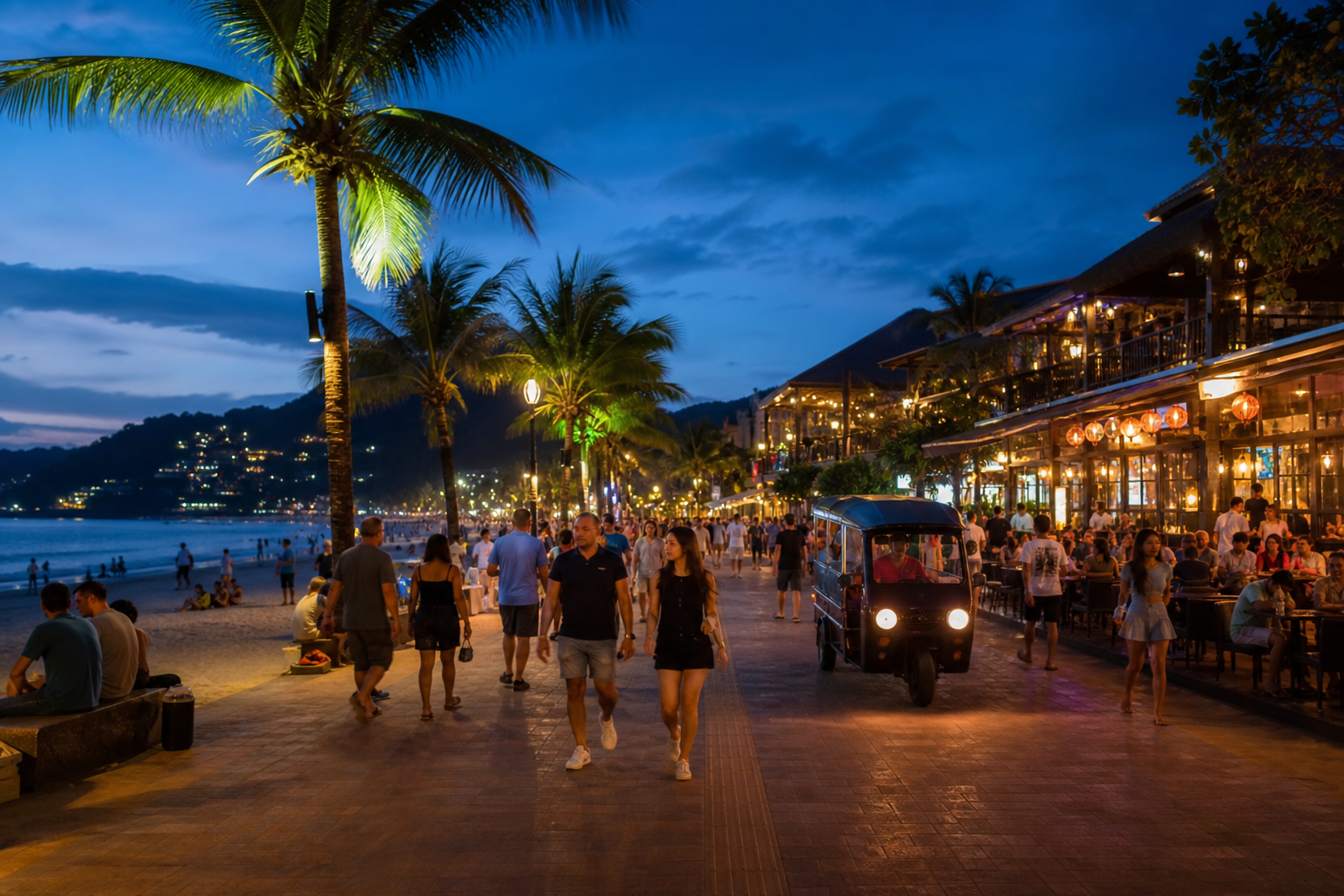
Patong is Phuket’s most intensely developed beach district. Phuket Province highlights its accommodation, restaurants, shopping, tour companies, entertainment, nightlife, and water-sport offerings. It is the easiest base in this guide for travelers who want many services within one area.
That convenience comes with crowds, traffic, noise, and a commercial atmosphere. Patong suits nightlife better than a secluded beach week.
Water activities may be advertised along the beach. Availability does not prove that conditions are appropriate or that a particular operator meets your needs. Before booking, clarify the total price, time, safety briefing, insurance position, cancellation terms, and exactly who operates the equipment. Walk away from pressure or unclear paperwork.
For swimming, use only the zone permitted that day. Busy surroundings do not protect against currents or sudden weather. Keep valuables secure and avoid leaving phones, cash, or passports unattended on the sand.
Patong is served by Phuket Smart Bus and has a wide accommodation range. Check the precise position: “Patong” can mean a nightlife street, hillside road, or quieter bay edge.
Best for: nightlife, shopping, first-time convenience, broad accommodation choice.
Less suitable for: quiet evenings, uncrowded surroundings, or a village-scale atmosphere.
[View Hotel Deals]
5. Karon Beach: long sand and more breathing room
Karon is one of the longer beaches in this comparison. Phuket Province notes restaurants, bars, shops, and tour companies, with Kata around three kilometers to the south. Its length creates a more spread-out feeling than compact Kata, although the road and commercial areas can still be busy.
The open shoreline is visually appealing, but more space does not mean fewer hazards. West-coast waves and currents can be powerful, particularly during unsettled monsoon weather. Check flags where you intend to enter rather than assuming conditions are identical along the entire beach.
Families may consider Karon for space and services, provided water decisions remain conservative. Nightlife is more moderate than Patong.
Accommodation ranges across different parts of Karon. A hotel near the northern end, center, or southern end can create a different walking experience, so inspect the location rather than relying only on the area name. The Smart Bus stops in Karon, but road crossings and the final walk with luggage deserve attention.
Karon Viewpoint overlooks Kata Noi, Kata, and Karon bays. The view does not replace a beach-level flag check.
Best for: long walks, more physical space, a middle ground between quiet and developed.
Less suitable for: travelers seeking everything within one compact pedestrian center.
6. Kata Beach: the practical all-rounder
The official Phuket description groups Kata Yai and Kata Noi and notes accommodation, shopping, entertainment, tour services, swimming, and diving lessons. For first-time visitors, Kata’s appeal is its balance: enough infrastructure to make the stay easy without matching Patong’s nightlife intensity.
Kata is often described as a swimming or surfing destination in different seasons. Treat those labels as activity context, not a green light. Swell, rip currents, crowding, lesson zones, and operator rules change. Beginners should use qualified instruction, suitable equipment, and the permitted area for that day.
Families may find the district practical because meals, shops, and lodging are available nearby. However, hills, traffic, heat, and the exact property entrance can make a short map distance feel longer. Confirm whether the hotel provides a shuttle or whether the route requires steep walking.
Kata lies on the Smart Bus route and works for selective outings to Karon Viewpoint, Nai Harn, Ya Nui, or Rawai.
Best for: first-time all-round convenience, mixed-age groups, moderate evenings.
Less suitable for: travelers wanting either complete seclusion or the island’s strongest nightlife.
7. Nai Harn Beach: southern scenery with seasonal current concerns
Nai Harn lies north of Promthep Cape, with a freshwater lagoon behind the beach. Its greener southern setting feels removed from the dense commercial environment of Patong.
The official Phuket Province page gives an unusually clear warning: from May to October, swimming is not recommended because of strong currents. Follow that advice along with current flags, forecasts, and lifeguard instructions. During unsafe conditions, a shaded walk, meal, or lagoon-side break is a better plan than entering the sea.
Nai Harn suits travelers wanting a quieter district and limited nightlife.
Private transport is often simpler here than relying on the main west-coast bus route. If using a taxi or ride-hailing service, confirm the pickup point before sunset because mobile reception, traffic, and driver availability can vary.
Accommodation spreads through the Nai Harn and Rawai districts. Check whether the beach route is genuinely walkable in heat.
Best for: southern scenery, quiet stays, land-based relaxation.
Less suitable for: swimming-focused trips during the May-October strong-current period.
8. Ya Nui Beach: a small cove, not a guaranteed calm pool
Ya Nui is a tiny cove between the Windmill viewpoint and Promthep Cape, close to Nai Harn and Rawai. Its scale is the attraction: a short strip of sand, rocky edges, and a more intimate setting than Phuket’s long resort beaches.
Small coves can look protected while still experiencing currents, swell, rocks, boat movement, or temporary marine warnings. Do not assume Ya Nui is safe because other people are in the water. Ask about the permitted zone and stay out when flags, weather, or local staff indicate risk.
Snorkeling and kayaking may be offered when conditions allow. Use a properly fitted buoyancy aid for paddling, keep away from boat routes, and never launch simply because equipment is available. If visibility, wind, or confidence is poor, choose a land-based visit.
Facilities are limited compared with Kata or Patong. Ya Nui works best as an outing from Nai Harn or Rawai.
Best for: small-cove atmosphere and a short southern-coast stop.
Less suitable for: extensive facilities, nightlife, or travelers who need everything beside their hotel.
Getting around: choose one base, then make selective trips
Phuket Smart Bus currently connects the airport with Surin, Kamala, Patong, Karon, Kata, and Rawai. Its current route page and timetable should be checked immediately before travel. Congestion can make road journeys much longer than the distance suggests.
Nai Yang is near the airport but not part of every west-coast hop. Nai Harn and Ya Nui commonly need an onward connection from the Rawai or Sai Yuan area, or private transport. A taxi, booked car, or hotel transfer may be more practical for luggage and small groups.
Motorcycles are not a casual solution for inexperienced riders. Phuket has steep, curved roads, heavy traffic, rain, and changing surfaces. Use a vehicle only if properly licensed, insured, trained, sober, and equipped with a helmet. Otherwise choose a professional driver or public transport.
For most first-time trips, select one base:
- Patong for nightlife and maximum services.
- Kata or Karon for a balanced west-coast holiday.
- Kamala for a calmer resort-town atmosphere.
- Nai Yang for airport convenience and quiet.
- Nai Harn/Rawai area for a slower southern stay with more transport planning.
Where to eat seafood and what to order
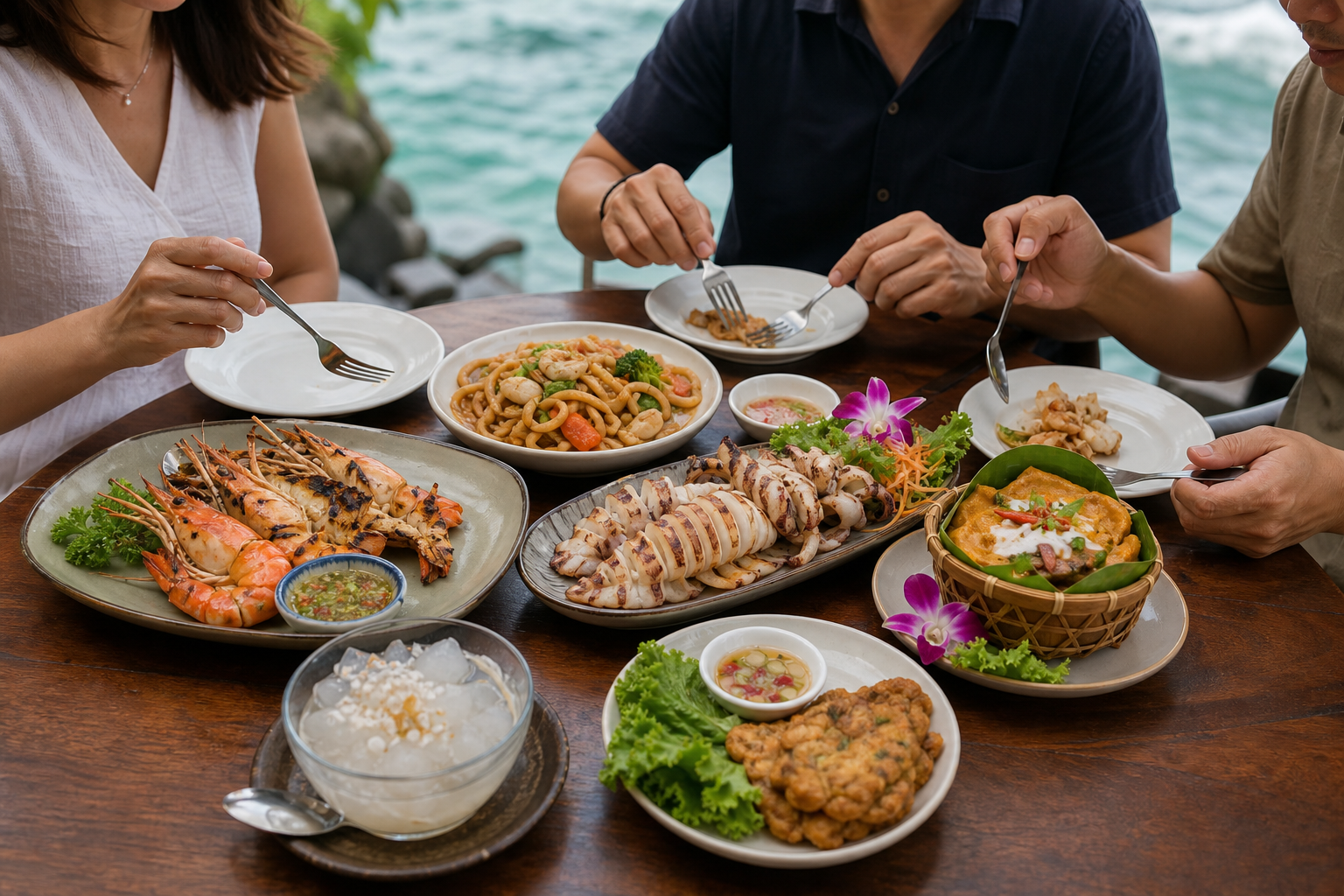
Rawai is useful as a south-coast boat and restaurant district, but it is not counted among the eight principal swimming beaches. Phuket Province describes long-tail and speedboat activity plus nearby accommodation and restaurants. Treat it as a food and harbor stop; confirm seafood prices, cooking fees, weight, and preparation before ordering.
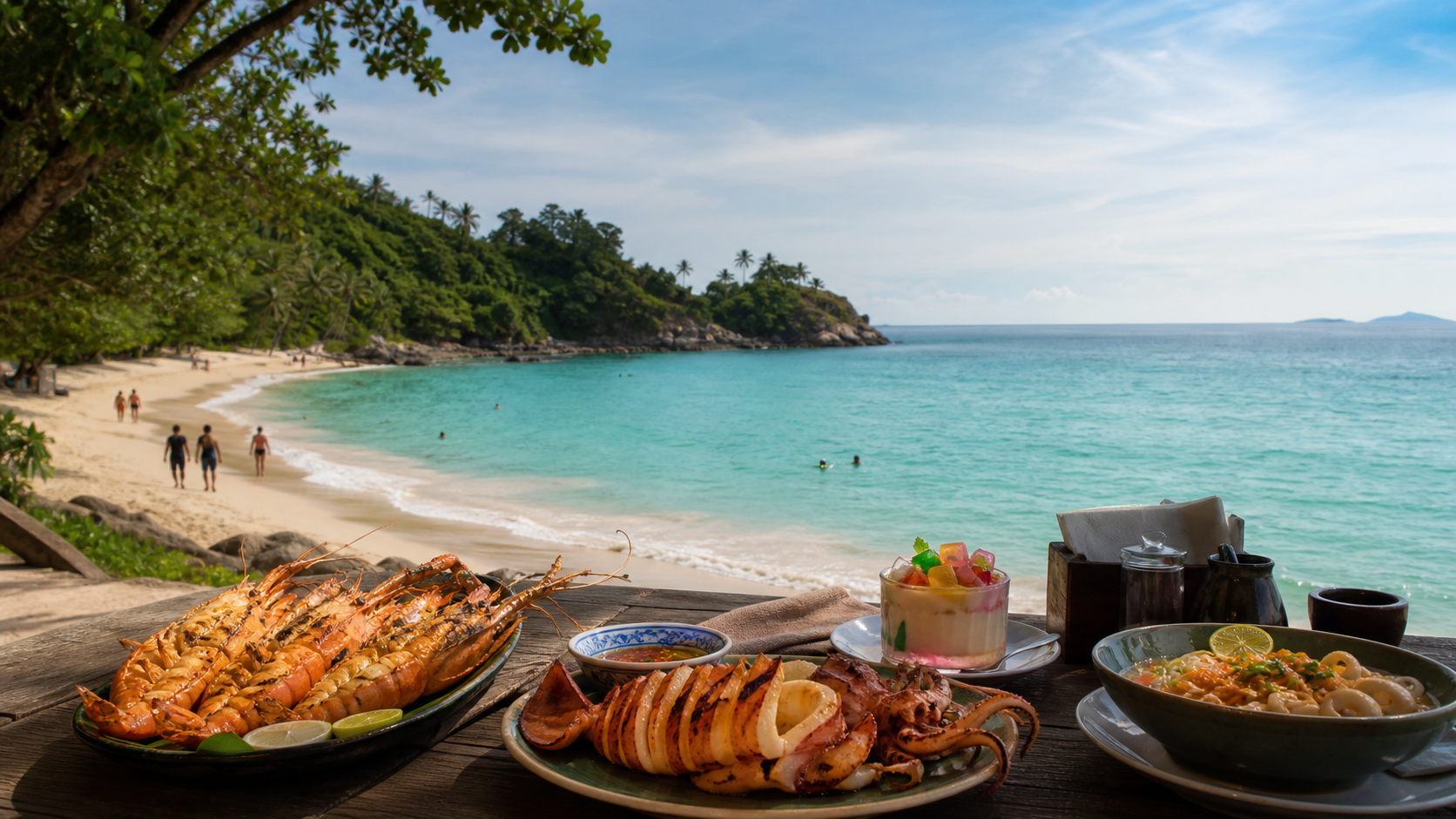
Across Phuket, look beyond generic fried rice. These ten ideas include seafood and local dishes documented by Phuket Province and official tourism material:
- Grilled prawns: confirm the price by weight or portion before cooking.
- Grilled squid: ask for it fully cooked and choose a busy stall or restaurant.
- Hor mok talay: seafood and curry custard steamed in a leaf or serving cup.
- Bue tod: a Phuket-style fried seafood or shrimp fritter with a crisp edge.
- Goong pad kapi: shrimp stir-fried with shrimp paste; powerful, savory flavor.
- Andaman fish balls: a simple seafood snack or soup addition.
- Phuket Hokkien mee: thick yellow noodles commonly cooked with seafood, pork, vegetables, and egg, with recipes varying by shop.
- O-tao: a local oyster-and-taro-style fried dish with a soft, chewy texture.
- Nam prik goong siap: chili dip with dried shrimp, usually eaten with vegetables.
- O-aew: a chilled local jelly dessert that works well after a hot beach day.
Lo ba, khanom jeen, a-pong, and moo hong are additional Phuket specialties, though not all are seafood dishes. If your priority is local food rather than a sea view, Phuket Town generally offers a deeper range than the beach strips.
Avoid describing a restaurant as operating until you verify it that day. Menus, seafood supply, prices, and opening days change. For allergies, carry a translated card and remember that fish sauce, shrimp paste, oyster sauce, and shared fryers can appear even in dishes without obvious seafood pieces.
How to choose your Phuket beach
Use a simple decision:
- Choose Patong if nightlife and convenience outweigh crowd concerns.
- Choose Kata for the easiest all-round first visit.
- Choose Karon for a longer beach and more spread-out atmosphere.
- Choose Kamala for quieter evenings with useful services.
- Choose Nai Yang when airport convenience matters.
- Visit Surin for scenery, while respecting its monsoon swimming warning.
- Choose Nai Harn for a quieter southern base, but not for a May-October swimming promise.
- Visit Ya Nui as a small-cove outing when conditions permit.
The strongest Phuket beach plan is not the one that collects the most names. It is the one that places you near the atmosphere you want, leaves time to read the sea, and makes it easy to change plans when a red flag, storm, current, or marine warning says the water must wait.
Leave a Reply