Table of Contents
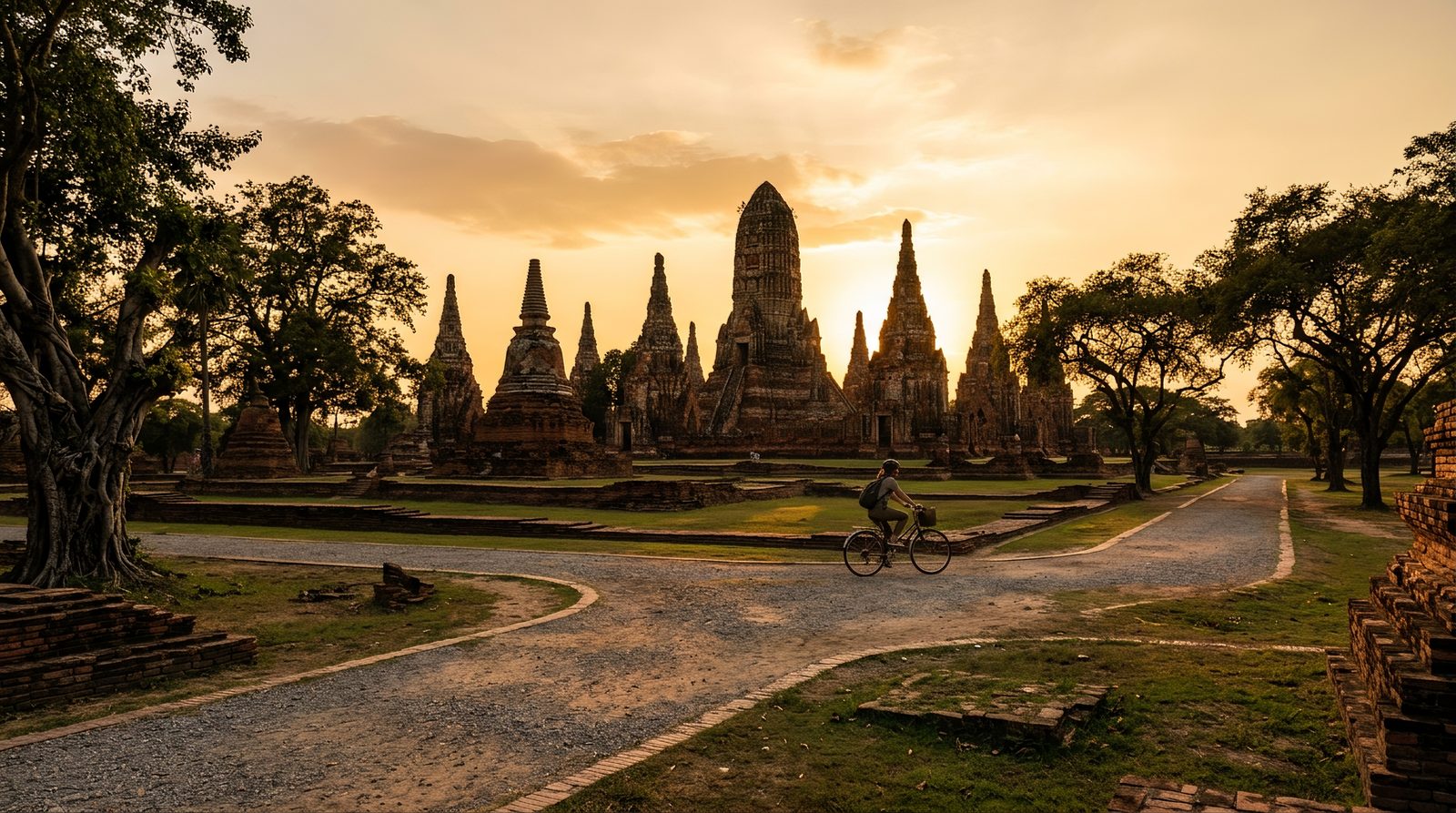
Ayutthaya is one of the easiest and most rewarding day trips from Bangkok. In a single day you can walk among the brick prangs and headless Buddha rows of a former Siamese capital, cycle past lotus ponds between UNESCO-listed ruins, and eat dishes this river city is known for — boat noodles, candy-floss roti, and charcoal-grilled giant river prawns. This guide covers how to get there by train, minivan, or car, which temples fit realistically into one day, what the tickets cost, and what to eat between ruins.
Disclosure: This article may contain affiliate links. If you make a booking through one of these links, we may earn a commission at no additional cost to you.
Information last verified: 2026-07-24. Prices, opening hours, entry fees, and transportation schedules may change. Confirm locally before you travel.
Why Ayutthaya deserves a full day
Founded around 1350, Ayutthaya succeeded Sukhothai as the capital of the Siamese kingdom and grew into one of the largest, most cosmopolitan cities of its era before Burmese forces destroyed it in 1767. The surviving temple cores — tall corn-cob prangs, rows of weathered Buddha images, and monastery platforms — were inscribed by UNESCO as the Historic City of Ayutthaya in 1991.
The ruins are spread across and around an island formed by three rivers, about 80 km north of central Bangkok. That distance is the good news: it is close enough that an early start gives you a full sightseeing day and still gets you back to Bangkok for dinner.
How to get to Ayutthaya from Bangkok
There are three practical ways to make the trip independently, plus organized tours if you prefer zero logistics.
| Option | Approx. cost (one way) | Approx. time | Best for |
|---|---|---|---|
| Train | from about 15–20 THB (ordinary, 3rd class) | about 1–2 hours | Atmosphere and price |
| Minivan | about 100–220 THB | about 1.5 hours | Speed on a budget |
| Grab / taxi | roughly 900–1,400 THB | about 1–1.5 hours | Groups and flexible timing |
| Private car with driver | roughly 2,000–4,200 THB per day | flexible | Families, full-day comfort |
By train
Trains are the classic way to reach Ayutthaya. Services depart from two Bangkok stations: long-distance trains (around 16 per day) leave from Krung Thep Aphiwat Central Terminal and take about an hour, while ordinary trains (around 11 per day) leave from Hua Lamphong and take about two hours with more stops. Ordinary third-class fares start at just 15–20 THB; faster trains and air-conditioned classes cost more. Note that ordinary-train tickets are sold at the station on the day of travel only, so arrive with a little buffer time.
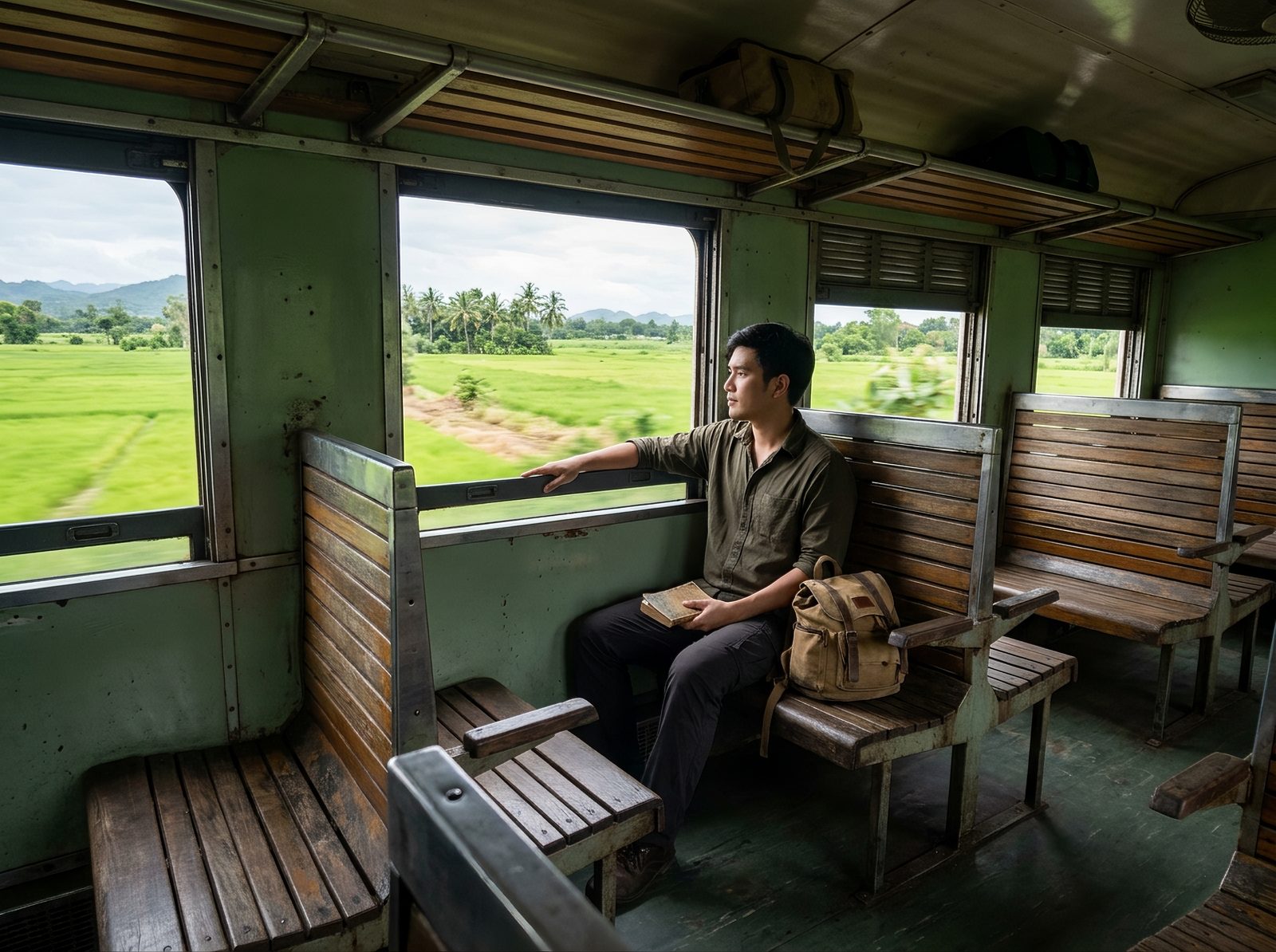
If you are staying near a BTS or MRT station, our guide to using the BTS and MRT in Bangkok explains how to reach the mainline rail stations; Krung Thep Aphiwat connects directly to the MRT Blue Line at Bang Sue.
The State Railway of Thailand has also announced a new air-conditioned commuter service between Krung Thep Aphiwat and Ayutthaya, with promotional fares of about 30–50 THB at launch. Check the official State Railway channels for current timetables, as schedules and services change.
By minivan
Minivans leave from the Mo Chit (Northern) terminal area roughly every hour from about 06:00 to 19:00. Expect to pay about 100–220 THB depending on the operator, with a journey of about 90 minutes when traffic is light. Friday and Sunday afternoons are slower. Minivans drop you in central Ayutthaya, closer to the ruins than the railway station.
By Grab, taxi, or private car
A Grab or metered taxi one way generally costs somewhere in the range of 900–1,400 THB and takes about an hour to an hour and a half depending on traffic. For a group of three or four, this can be worth it for the door-to-door convenience. A private car with a driver for the whole day — Bangkok pickup, temple stops, and return — is typically quoted at roughly 2,000–4,200 THB depending on the vehicle, which travelers who want air-conditioned comfort between every stop may consider.
Should you take a tour instead?
Organized day tours from Bangkok typically bundle hotel pickup, an English-speaking guide, lunch, and three to four headline temples into one seat-and-forget package; some itineraries return to Bangkok by riverboat along the Chao Phraya, trading speed for scenery. A tour makes sense if your time is tight and you value historical narration over freedom to linger. The trade-offs are a fixed clock at every stop, midday arrivals at the busiest sites, and per-person prices that usually exceed what a small group would pay for a private car. Travelers who want the stories without the schedule may consider hiring a licensed local guide at the park instead and keeping transport independent.
Arriving at Ayutthaya station
Ayutthaya's railway station sits east of the island, across the Pa Sak River and about 4 km by road from the central ruins. You have two simple options: take the short cross-river ferry (about 5 THB) from the pier near the station and continue on foot or by rented bicycle, or take a tuk-tuk from the station forecourt to the historical park for roughly 100–150 THB.
Getting around the ruins
The island is flat, and the headline temples sit within a compact central zone, which makes getting around straightforward:
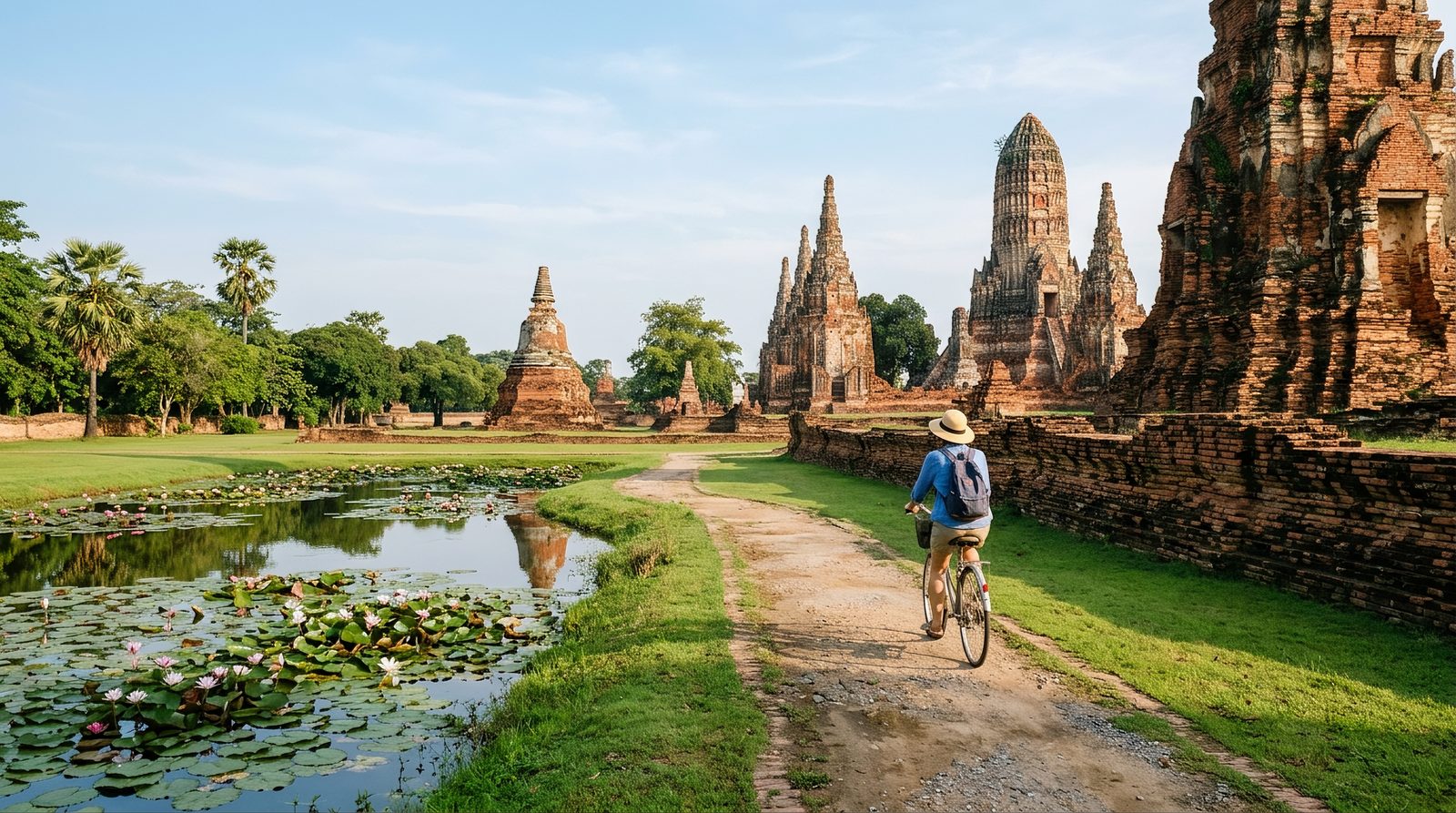
- Bicycle — rental shops near the station and around the guesthouse area charge about 50–100 THB per day. Cycling between ruins past moats and lotus ponds is half the pleasure of the day; carry water and sun protection.
- Hired tuk-tuk — figure roughly 200–300 THB per hour, or roughly 500–1,500 THB for a day depending on hours and negotiation. Agree the route, stops, and price clearly before you set off.
- Songthaew — shared covered pickups run fixed routes for about 20–40 THB per person, useful for single hops.
A practical pattern for one day: cycle or tuk-tuk between the island temples in the morning, then use a tuk-tuk for the two out-of-town temples in the afternoon.
The one-day temple circuit
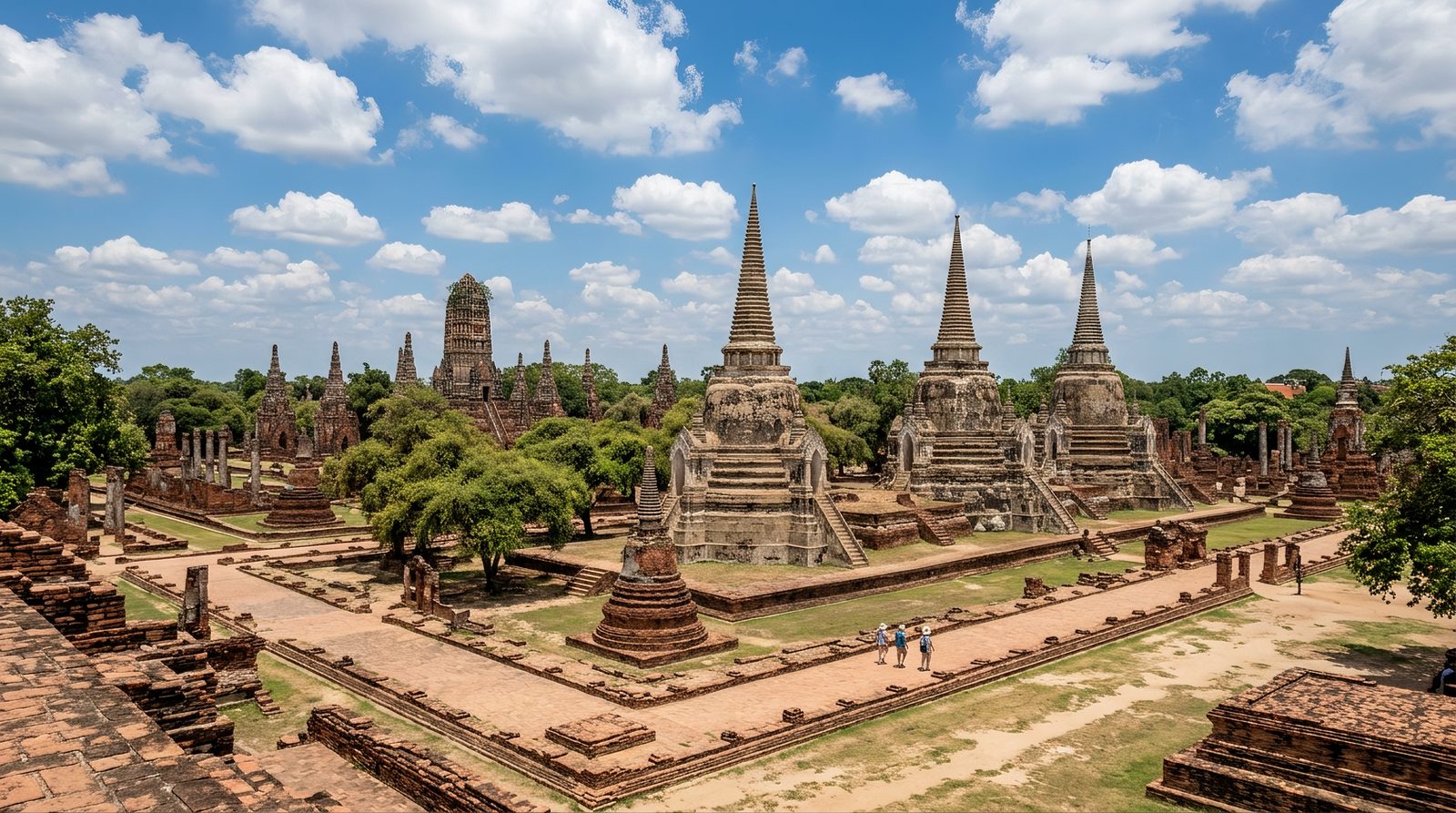
There is no park-wide entry gate. Major sites charge about 50 THB each for foreign visitors, and smaller sites about 20 THB or nothing. If you plan four or more of the big names, the combined ticket (about 220 THB) covers six sites — Wat Mahathat, Wat Ratchaburana, Wat Phra Si Sanphet, Wat Phra Ram, Wat Chaiwatthanaram, and Wat Maheyong — and is valid for 30 days. It is sold in cash at the ticket window of any included temple. Most sites open roughly 08:00–18:00 daily, though hours can change.
Wat Mahathat
Start here early, before the tour buses. The "Temple of the Great Relic" is home to Ayutthaya's most photographed sight: a sandstone Buddha head cradled in the roots of a banyan tree. Beyond that single image, the sprawling grounds of collapsed prangs and seated Buddha rows reward a slow walk. When photographing the Buddha head, crouch so your head is not higher than the Buddha's — a sign and often an attendant will remind you.
Wat Ratchaburana
Directly across the road from Wat Mahathat, this 15th-century temple centers on a well-preserved Khmer-style prang. It is quieter than its neighbor, and the two pair naturally as a single stop.
Wat Phra Si Sanphet
A short ride west, three restored bell-shaped chedis stand in a photogenic row on the grounds of the former royal palace. This was the model for Wat Phra Kaew in Bangkok, and its silhouette is the emblem of Ayutthaya. The adjacent Wihan Phra Mongkhon Bophit houses a large bronze seated Buddha and is free to enter.
Wat Lokkayasutharam
A short pedal further west brings you to a monumental open-air reclining Buddha resting in the field where its temple once stood. Access has generally been free and unfenced; check locally, as restoration work can change access.
Wat Yai Chai Mongkhon
Southeast of the island (a tuk-tuk or a longer cycle), this active temple pairs a massive climbable chedi with rows of saffron-draped Buddha images. Because it is a working temple, dress and behave accordingly.
Wat Chaiwatthanaram
End the circuit at the riverside showpiece southwest of the island. Built in the 17th century in Khmer style, its symmetrical prangs beside the Chao Phraya River are especially photogenic in the late-afternoon light, and the site is a popular sunset stop — many visitors rent traditional Thai costumes nearby for photos.
What to eat in Ayutthaya
Ayutthaya's food is reason enough for the trip. Three things define eating here:
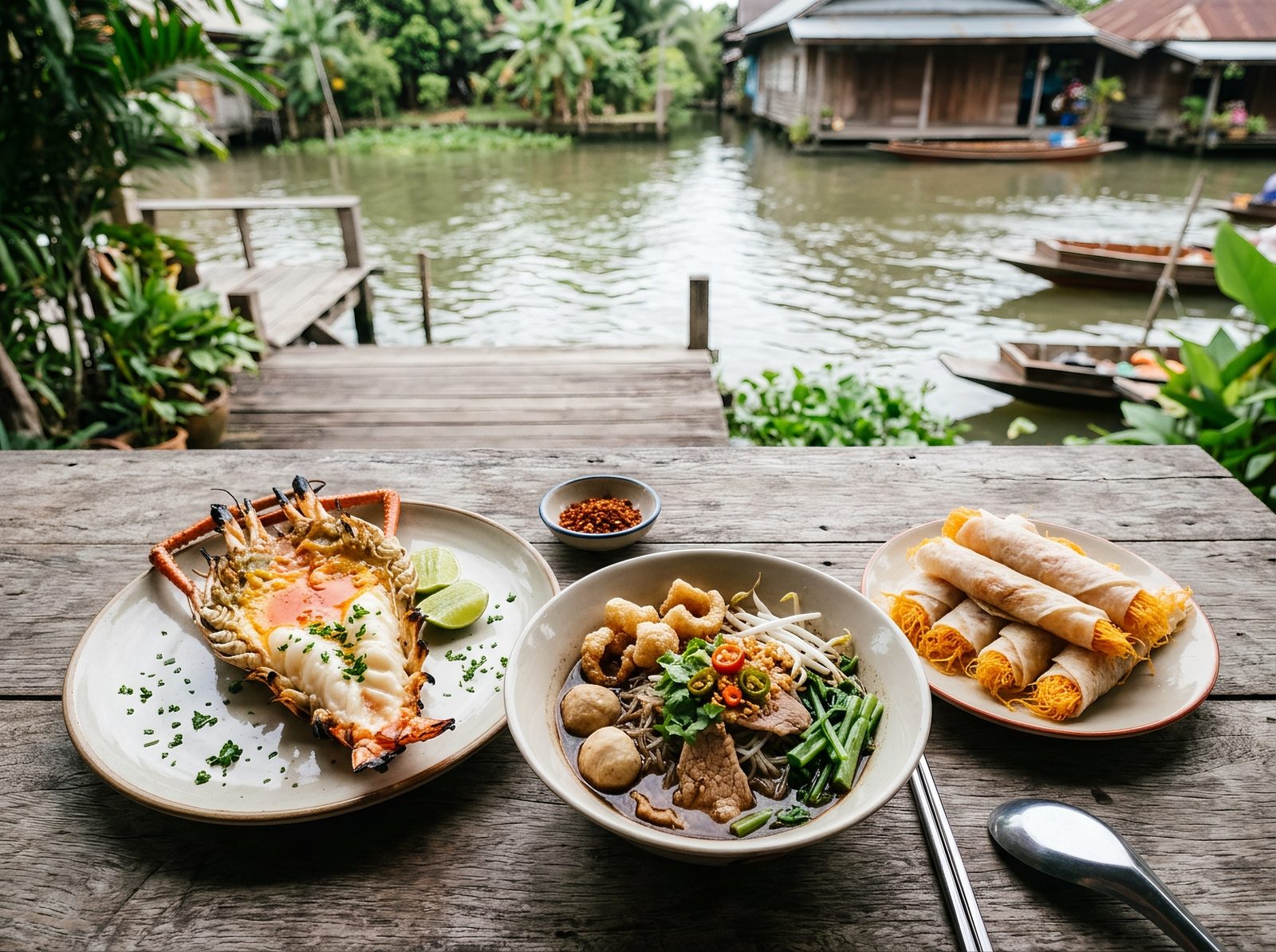
Boat noodles (kuay tiao ruea). The dish now found all over Thailand has deep roots in Ayutthaya, where vendors once sold it from wooden boats on the canals. Expect small, intense bowls — rice noodles in a dark, herbal pork or beef broth — priced so you can order several. Noodle shops cluster around the island; ordering "moo" (pork) or "neua" (beef) is all the menu Thai you need.
Roti sai mai. Ayutthaya's signature sweet reflects the city's centuries-old Muslim community: threads of spun palm-sugar "candy floss" that you roll up yourself in a thin, soft roti. Stalls cluster famously along the road in front of Ayutthaya Hospital, with bags of pastel sugar threads and fresh roti made to order. It travels well — take a bag back to Bangkok.
Grilled giant river prawns (goong mae nam phao). Central Thailand's rivers produce enormous freshwater prawns, split and grilled over charcoal until the orange head fat bubbles. Riverside restaurants around the island grill them to order, usually sold by weight — confirm the per-kilogram price before ordering, as these are a premium item.
If you get back to Bangkok hungry, our Yaowarat night food walk makes a fitting same-day finale.
A realistic one-day itinerary
- 07:00 — Depart Bangkok (train from Krung Thep Aphiwat, or minivan from Mo Chit).
- 08:30 — Arrive Ayutthaya; cross by ferry or tuk-tuk; rent a bicycle or agree a tuk-tuk day rate.
- 09:00 — Wat Mahathat and Wat Ratchaburana while the light is soft and crowds thin.
- 11:00 — Wat Phra Si Sanphet and Wihan Phra Mongkhon Bophit.
- 12:00 — Boat-noodle lunch, then roti sai mai near Ayutthaya Hospital.
- 13:30 — Wat Lokkayasutharam's reclining Buddha, then break for something cold during peak heat.
- 15:00 — Wat Yai Chai Mongkhon southeast of the island.
- 16:30 — Wat Chaiwatthanaram for late-afternoon light by the river.
- 18:00 — Riverside grilled-prawn dinner, or head back and eat in Bangkok.
- 19:00 — Return by evening train or minivan.
Practical tips
- Dress code: Several sites, especially active temples like Wat Yai Chai Mongkhon, expect covered shoulders and knees. Light long layers beat shorts here.
- Heat: The ruins offer little shade. Do your hardest walking before noon, drink more water than feels necessary, and build in an air-conditioned break.
- Cash: Ticket windows and food stalls are cash-first; bring small notes.
- Respect the ruins: Do not climb on fragile brickwork or pose above Buddha images. Keep your head lower than the Wat Mahathat Buddha head when photographing it.
- Elephant rides: You will see elephant rides offered near the ruins. Animal-welfare organizations discourage riding; we do not recommend it.
- Best time of year: The cool season from roughly November to February is the most comfortable for cycling between ruins. March to May brings intense heat — plan a slower day with more breaks. The rainy months around July to October mean greener grounds and dramatic skies, with showers that usually pass; paths can be muddy after rain.
- Overnight option: If sunset at Wat Chaiwatthanaram tempts you to slow down, Ayutthaya has riverside guesthouses and hotels, and staying over lets you see the ruins lit at night and beat the crowds next morning.
Frequently asked questions
Is Ayutthaya worth visiting as a day trip? Yes — it is one of the classic day trips from Bangkok. The core temples fit comfortably into one day, and the journey takes as little as an hour each way.
How much does an Ayutthaya day trip cost? An independent budget version can run under 500 THB per person: an ordinary train (from about 15–20 THB each way), a bicycle (about 50–100 THB), three or four temple tickets (about 50 THB each or a 220 THB six-site pass), and street food. Tours, private cars, and prawn dinners raise it from there.
Which temples should I prioritize if I only have half a day? Wat Mahathat, Wat Phra Si Sanphet, and Wat Chaiwatthanaram cover the Buddha head, the three-chedi skyline, and the riverside showpiece.
Can I do Ayutthaya without a tour? Easily. Trains and minivans run all day, bicycles and tuk-tuks handle the ground, and the sites need no guide to enjoy — though a good guide adds historical depth.
Is Ayutthaya manageable with children? Yes, with heat management. Distances between the central temples are short, tuk-tuks make hopping easy, and kids tend to love the ferry crossing and the Buddha head in the tree roots. Plan an air-conditioned midday break and keep climbing on the ruins off the agenda.
When is the best time of day to visit? Early morning and late afternoon: cooler air, softer light, and thinner crowds. Aim to arrive by 08:30–09:00 when sites open around 08:00.
Final thoughts
Ayutthaya rewards a simple plan: leave Bangkok early, see the island temples in the morning, eat like the locals at midday, and save the riverside ruins for the golden hour. For more Bangkok-based planning, see our one-day Old Town temples and street food itinerary and our BTS and MRT guide.
Image note: Editorial images in this article are generated with AI for illustration; they do not depict specific properties, businesses, or exact monuments as documentary photographs.
Leave a Reply